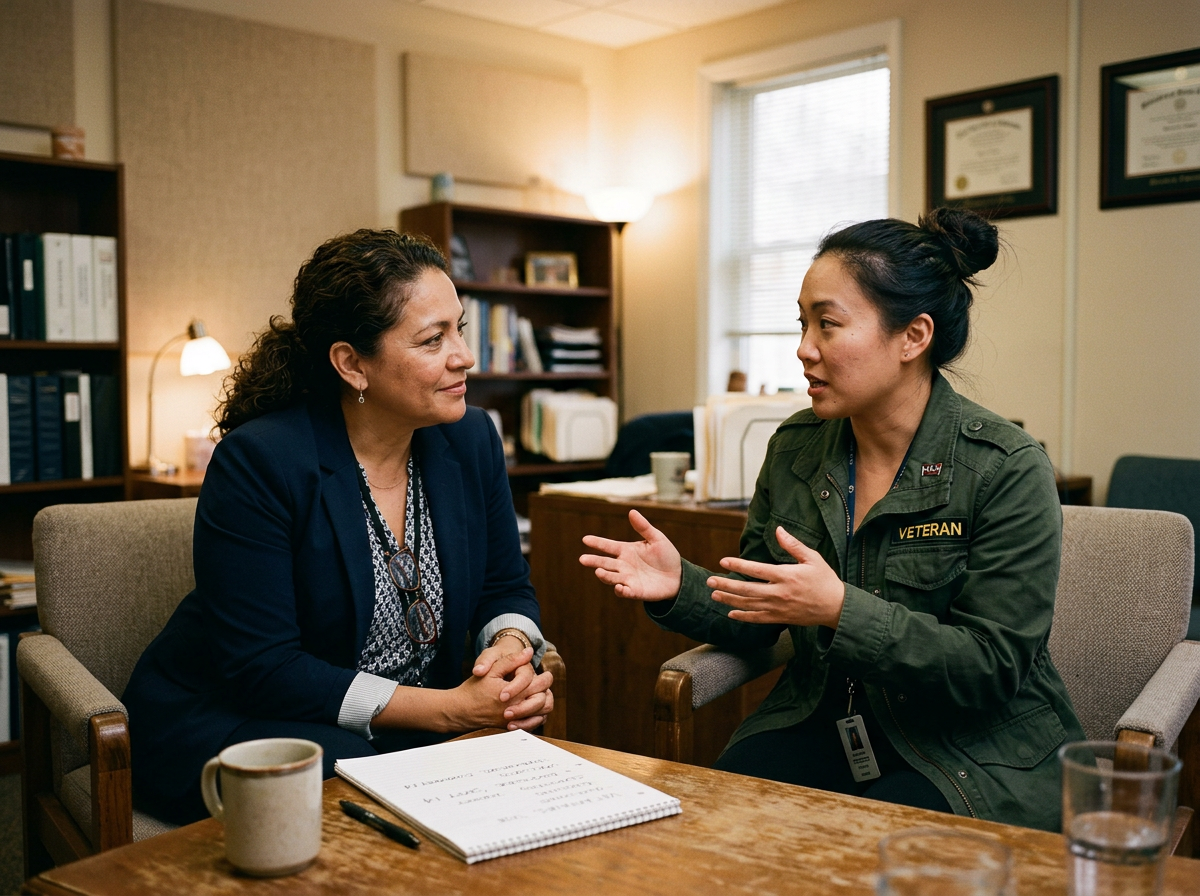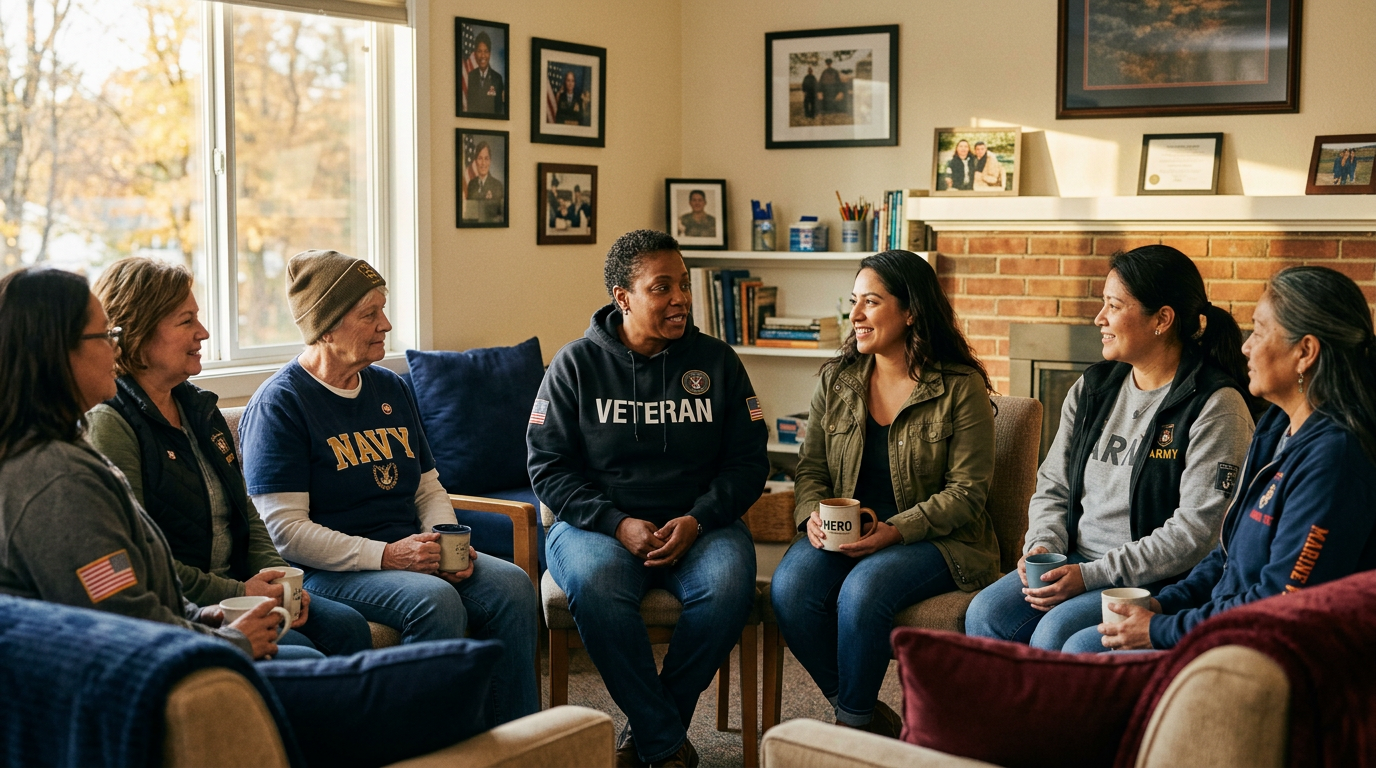
Peer Support & Community for Women Veterans
You served alongside other women. You do not have to navigate the aftermath alone. This guide covers every peer support program, mentoring network, community organization, and crisis resource available to women veterans — so you can find the people who understand without needing it explained.
VA Peer Support — Veterans Helping Veterans
The VA employs over 1,200 certified peer specialists nationwide — veterans who have lived through mental health challenges, substance use, or homelessness and are trained to help you do the same. Peer specialists work inside VA Medical Centers, community-based outpatient clinics, and housing programs. They are not therapists; they are fellow veterans who sit across from you and say, "I\'ve been there. Here is what helped me." Below are the four main VA peer support pathways open to women veterans.
Peer Specialist Program
The VA employs certified peer specialists — veterans who have lived experience with mental health conditions, substance use, or homelessness and have been trained to support others. They work inside VA Medical Centers, CBOCs, and HUD-VASH housing programs. Peer specialists do not replace therapists; they walk alongside you, share coping strategies, help you navigate VA systems, and serve as proof that recovery is real. Under 38 CFR §17.43, peer specialists are integrated into VA mental health teams. Ask your VA mental health provider about adding a peer specialist to your care team, or request one through the Patient Advocate.
Women Veterans Peer Groups
Many VA Medical Centers now run peer support groups specifically for women veterans. These groups are facilitated by female peer specialists or social workers and cover topics like MST recovery, combat stress, parenting as a veteran, transition challenges, and healthy relationships. Groups meet weekly or biweekly. The environment is women-only, which matters — research published in the Journal of Traumatic Stress shows women veterans participate more openly and report greater therapeutic benefit in gender-specific groups. Contact your facility's Women Veterans Program Manager (WVPM) to find out what groups meet at your VA.
Whole Health Peer Groups
VA's Whole Health initiative includes peer-led groups focused on holistic wellness — mindfulness, yoga, nutrition, creative arts, and personal mission exploration. These are not traditional therapy groups; they are participatory workshops where veterans support each other in building healthier lives. Whole Health peer facilitators (called Whole Health Partners) are fellow veterans trained in the VA's Circle of Health model. Available at most VA Medical Centers; check your facility's Whole Health page or ask your primary care team.
Caregiver Peer Support
If you are both a veteran and a caregiver — caring for a spouse, parent, or another veteran — VA's Program of General Caregiver Support Services (PGCSS) includes peer support mentoring. A trained caregiver peer mentor can help you manage the dual burden of your own service-connected conditions while supporting someone else. The Caregiver Support Line at 1-855-260-3274 can connect you. Separately, the Elizabeth Dole Foundation's Hidden Heroes program runs a national peer mentoring network specifically for military and veteran caregivers.
How to request a peer specialist: Tell your VA mental health provider, primary care doctor, or social worker that you want peer support added to your care plan. You can also contact your facility\'s Patient Advocate or Women Veterans Program Manager (WVPM). Peer specialist services are available at no cost as part of your VA mental health care. If your facility does not yet have a women-focused peer group, your WVPM can often organize one — ask.
Vet Centers — Community-Based Peer Support
There are over 300 Vet Centers across the United States, staffed by licensed counselors — many of them veterans. Vet Centers are deliberately not hospitals. They are community-based, low-key, and free. Under 38 U.S.C. §1712A, any veteran who served in a combat zone, experienced military sexual trauma, or supported combat operations as a drone crew member is eligible — regardless of discharge character, VA enrollment, or disability rating. No referral needed. Walk in or call.
Community Setting, Not a Hospital
Vet Centers are deliberately located outside VA Medical Centers — in strip malls, office parks, and downtown buildings. The atmosphere is casual and non-clinical. You walk in, grab coffee, and talk. There are no hospital gowns, no waiting rooms full of strangers. This matters for veterans who associate medical facilities with negative experiences or who avoid the VA system entirely.
Counseling at No Cost
Individual, group, couples, and family readjustment counseling — all free, regardless of your VA enrollment status or discharge character. Vet Center counselors are licensed mental health professionals, and many are veterans themselves. You do not need a VA disability rating or a service-connected condition to use a Vet Center. Under 38 U.S.C. §1712A, any veteran who served in a combat zone, experienced MST, or served on a drone crew supporting combat operations is eligible.
Women-Specific Groups
Many Vet Centers run groups exclusively for women veterans — covering transition stress, MST recovery, relationship challenges, parenting, and career building. Ask your local Vet Center about women's groups. If your nearest center does not have one, the counselor can often start one if there is enough interest, or connect you with a nearby center that does.
Mobile Vet Centers
The VA operates over 80 Mobile Vet Centers — custom vehicles that bring counseling directly to communities, military installations, college campuses, and events. Mobile Vet Centers are staffed by licensed counselors and go where veterans are. They are particularly useful in rural areas where the nearest brick-and-mortar Vet Center may be hours away. Find Mobile Vet Center schedules at VA.gov/find-locations or by calling 1-877-927-8387.
Mentoring Programs for Women Veterans
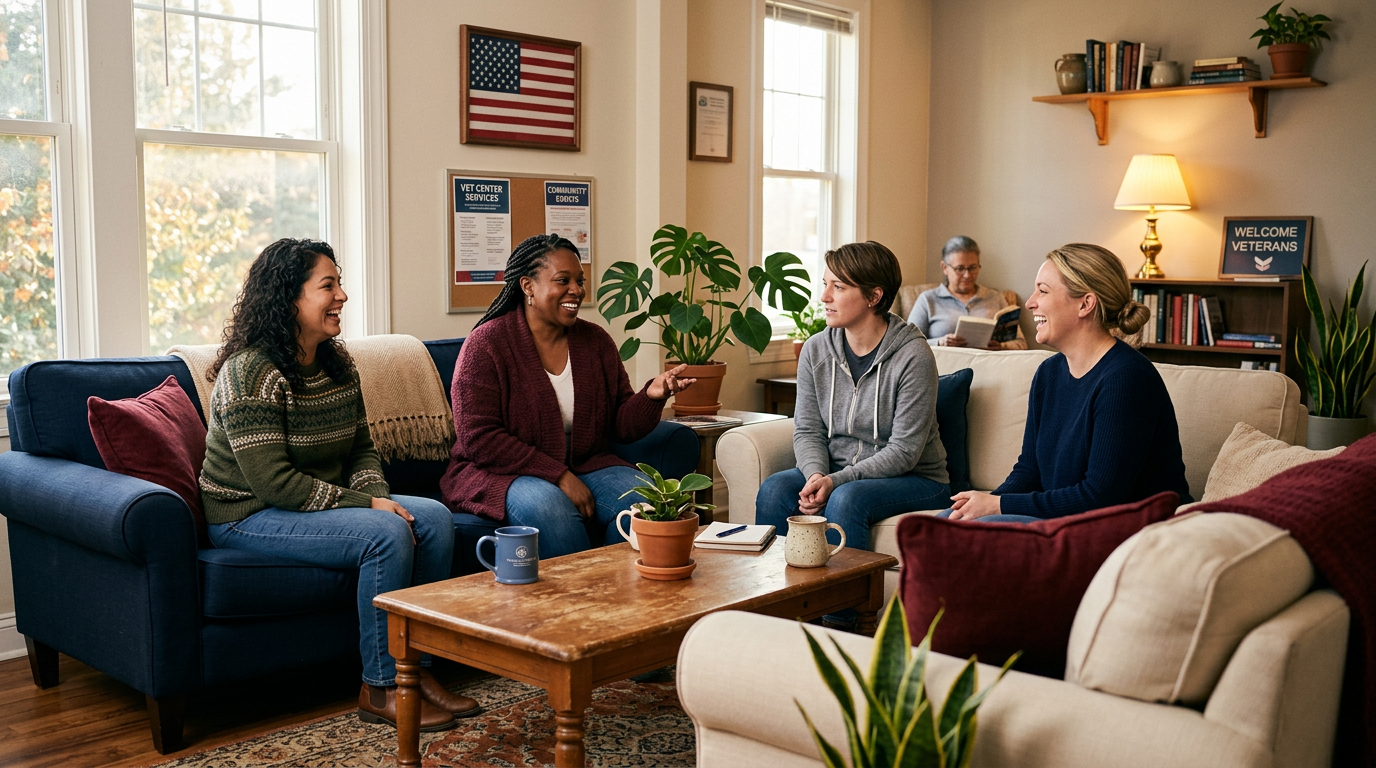
A mentor does not replace a therapist — a mentor replaces the squad leader, the senior NCO, the officer who had your back. These programs pair you with someone who has walked a similar road and can help you navigate what comes next — career moves, business launches, or simply building a civilian life that feels like it fits.
American Corporate Partners (ACP)
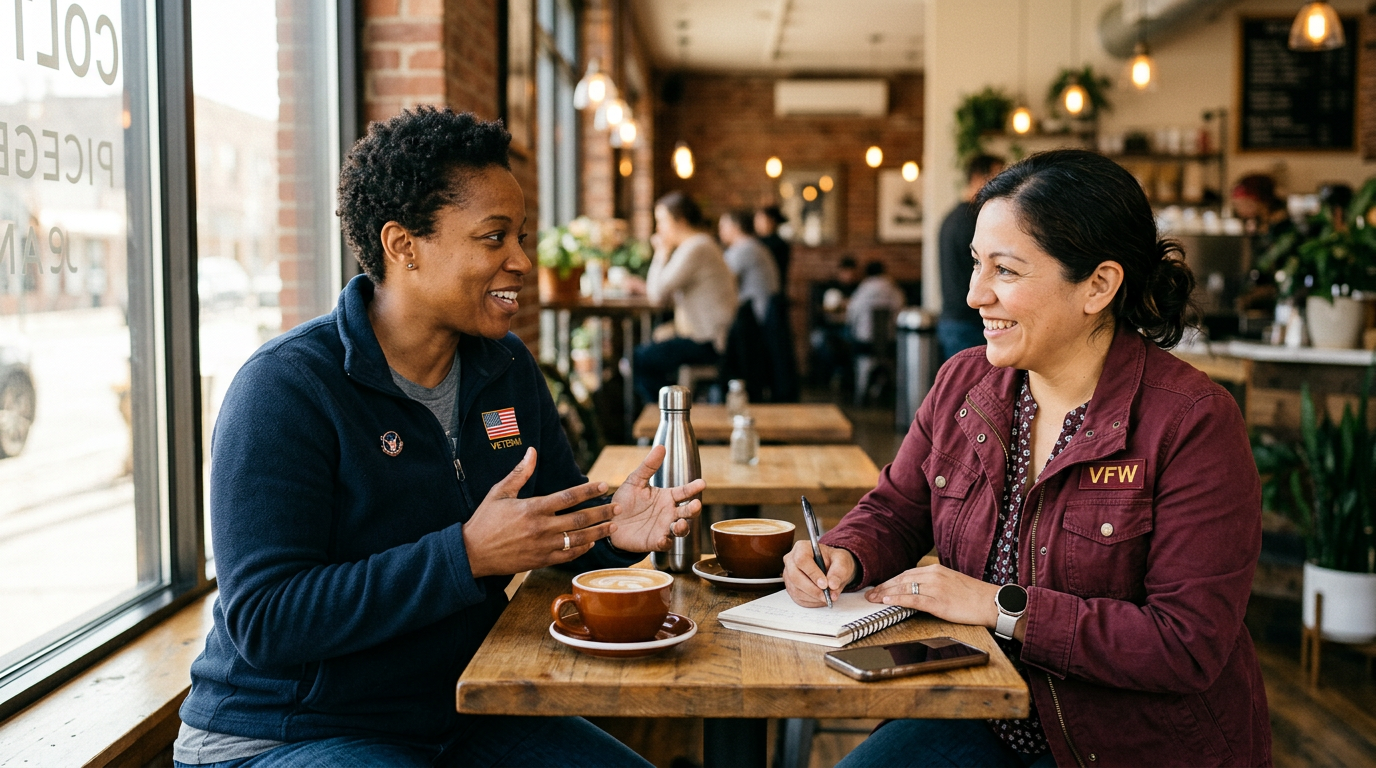
ACP pairs transitioning service members and veterans with corporate professionals for year-long mentoring relationships. Mentors come from companies like Goldman Sachs, Johnson & Johnson, Pfizer, and Deloitte. The focus is career development — résumé review, interview skills, networking, and industry navigation. ACP is free and runs entirely online, making it accessible regardless of your location. Over 25,000 veterans have been mentored through ACP since 2008. Apply at acp-usa.org.
Women Veterans Network (WoVeN)
Disabled American Veterans (DAV) runs the Women Veterans Network — a nationwide peer-to-peer community specifically for women who served. WoVeN chapters host local meetups, retreats, volunteer activities, and networking events. The network provides a ready-made community of women who understand military service without needing it explained. WoVeN is free to join and does not require DAV membership. Find your nearest chapter or join virtually at dav.org/women-veterans.
SCORE Veteran Mentoring
If you are starting a business or side hustle, SCORE provides free mentoring from experienced business professionals. SCORE is an SBA resource partner with over 10,000 volunteer mentors across 250+ chapters. They offer one-on-one mentoring, workshops, and online courses covering business plans, marketing, finances, and operations. Many SCORE mentors are veterans themselves. Find a mentor at score.org.
PsychArmor Peer Support Training
PsychArmor Institute offers free online courses that train veterans and family members to become effective peer supporters. Their courses cover active listening, crisis intervention, cultural competency, and how to connect peers with professional resources when needed. If you want to become a peer supporter yourself — or simply learn how to better support fellow veterans in your community — PsychArmor's self-paced courses at psycharmor.org are the starting point.
Online Communities & Virtual Connection
Not every veteran can drive to a VA facility or attend an in-person meetup. Online communities give you 24/7 access to women who have served — for advice, solidarity, a vent session at 2 a.m., or a job lead you would never find on your own. These platforms range from massive Facebook groups to niche subreddits, and they all share one thing: they are spaces where you do not have to explain what your service was like.
Women Veterans Alliance
A Facebook community of over 40,000 women veterans sharing resources, job opportunities, legal advice, and mutual support. The group is moderated, women-only, and covers everything from claims tips to parenting challenges to deployment memories. It is one of the largest online spaces where women veterans can connect without explaining what their service was like.
VA Women Veterans Community
The VA's Center for Women Veterans maintains a web presence and social media channels connecting women veterans to benefits, events, and each other. Follow the Center for Women Veterans on Facebook, Instagram, and X for updates on programs, policy changes, and community stories. The Center also hosts virtual town halls where women veterans can ask questions directly to VA leadership.
RallyPoint
RallyPoint is a professional social network for military service members and veterans — often called "LinkedIn for the military." It features discussion forums, career resources, mentoring connections, and a verified community where your service is authenticated. RallyPoint has over 2 million members and allows you to connect with other women veterans across branches and eras.
Reddit r/VeteranWomen
A moderated subreddit for women veterans to discuss VA benefits, military transition, mental health, career moves, and life after service. The community is smaller but candid — women share real experiences without the polished veneer of official channels. Anonymity allows frank discussion of sensitive topics including MST, disability claims strategy, and navigating the VA system.
Organizations That Serve Women Veterans
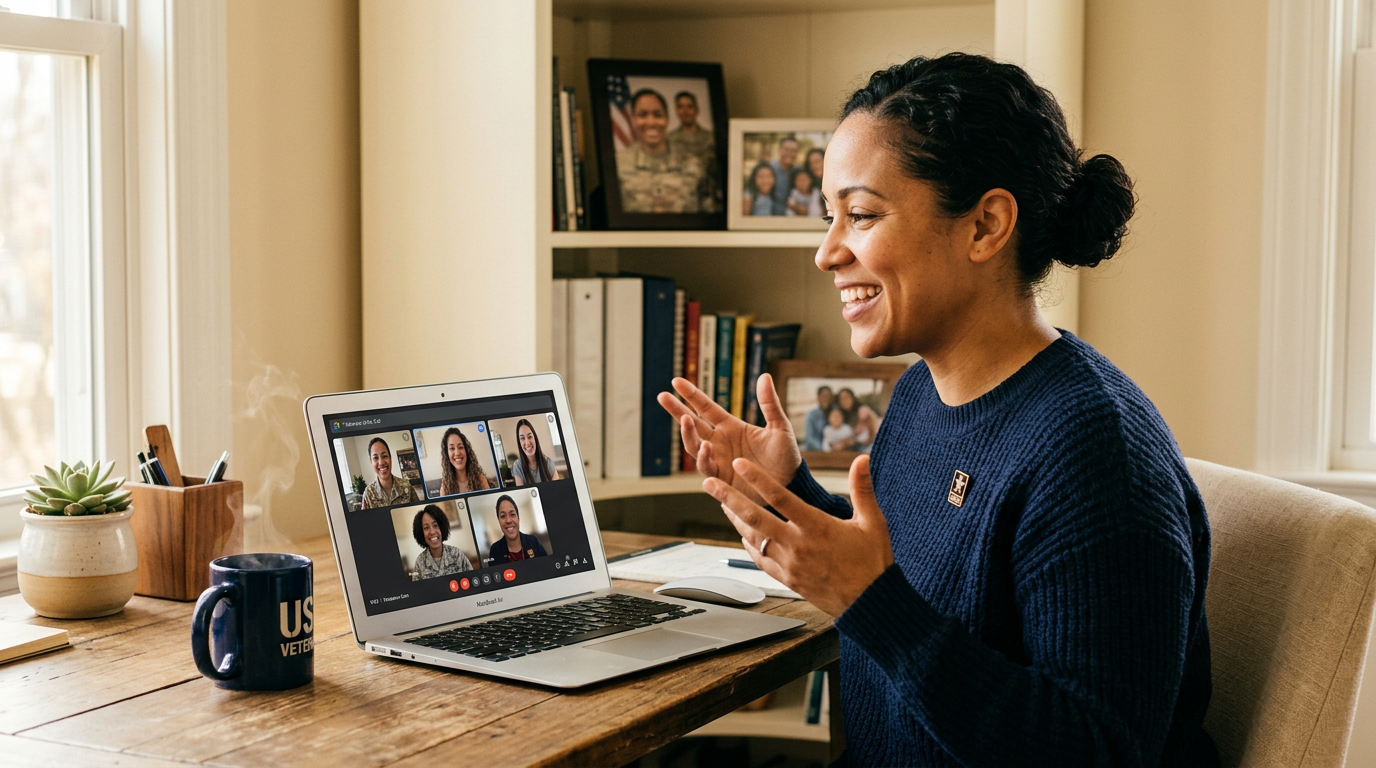
These nonprofits exist because women veterans were underserved for decades. Each one was built — most by women veterans themselves — to fill gaps the VA and traditional veteran service organizations left open. They offer retreats, housing, advocacy, fitness communities, and the kind of peer connection that only comes from shared experience.
Final Salute Inc.
Provides housing assistance to homeless women veterans and their children. Founded by Jas Boothe, a veteran and cancer survivor, Final Salute operates transitional housing in multiple states and has served thousands of women veterans since 2010. Their SSVF (Supportive Services for Veteran Families) program provides rapid rehousing, financial assistance, and case management. Contact: finalsaluteinc.org or 571-305-7929.
Grace After Fire
A Texas-based nonprofit that runs peer support retreats, wellness workshops, and community programs exclusively for women veterans. Their signature "Healing and Coping" weekend retreats bring together 20–30 women veterans for peer-led workshops, outdoor activities, and connection-building in a safe environment. Programs are free and include travel and lodging. Visit graceafterfire.org.
Service Women's Action Network (SWAN)
SWAN advocates for policy changes that affect women in the military and women veterans — including sexual assault prevention, healthcare access, and employment equality. Beyond advocacy, SWAN connects women veterans through events, campaigns, and a national network. Their research and policy work has directly influenced VA healthcare improvements for women. Visit servicewomen.org.
Team Red White & Blue
Team RWB builds communities through physical and social activities — group runs, hikes, yoga, social events, and volunteer service. With over 200 chapters nationwide, Team RWB provides an instant local community of veterans and supporters. Many chapters have strong women veteran participation. All activities are free and open to veterans, active duty, and supporters. Find your chapter at teamrwb.org.
Crisis Resources — When You Need Help Now
Peer support is for the long haul. Crisis lines are for right now. If you are in danger, experiencing suicidal thoughts, dealing with domestic violence, or in a substance use emergency, these resources are staffed 24/7 by people trained to help. You do not need to be enrolled in VA care. You do not need a disability rating. You just need to call.
Veterans Crisis Line
988 → Press 1
Available 24/7/365 by phone, text (838255), or online chat at VeteransCrisisLine.net. Confidential, free, staffed by trained VA responders — many of whom are veterans. You do not need to be enrolled in VA healthcare or have a service-connected disability to use the Crisis Line. If you are in immediate danger, call 911.
Women Veterans Call Center
1-855-829-6636
Mon–Fri 8am–10pm ET, Sat 8am–6:30pm ET. Staffed by women veterans who help other women veterans navigate VA benefits, healthcare, mental health services, and community resources. This is not a crisis line — it is a warm, knowledgeable gateway to the VA system, run by women who understand your experience.
National Domestic Violence Hotline
1-800-799-7233
Available 24/7 with advocates who understand military culture. Text START to 88788 or chat at thehotline.org. Intimate partner violence affects veterans at higher rates than the civilian population, and women veterans face unique barriers to seeking help. VA's Intimate Partner Violence Assistance Program (IPVAP) provides clinical services at VA Medical Centers — ask your WVPM for a referral.
SAMHSA National Helpline
1-800-662-4357
Free, confidential, 24/7 treatment referral and information service for substance use disorders and mental health. SAMHSA can connect you with local treatment facilities, support groups, and community organizations. Available in English and Spanish.
Five Steps to Your First Peer Connection
Walking into a room of strangers — even fellow veterans — takes courage. These five steps make it easier. You do not have to do them all at once, and you do not have to do them alone.
Identify What You Need
Peer support is not one-size-fits-all. Do you want to process combat or MST experiences? Build a professional network? Find women veterans in your area? Start a business? Just want coffee with someone who gets it? The answer shapes which program or community fits best.
Contact Your WVPM
Every VA Medical Center has a Women Veterans Program Manager. Call your VA facility and ask for the WVPM by name. She can tell you what peer groups meet locally, connect you with a VA peer specialist, and point you toward community organizations. This one call opens every VA-based door.
Walk Into a Vet Center
No appointment, no enrollment, no paperwork for a first visit. Vet Centers exist specifically to be low-barrier. Grab coffee, talk to a counselor, ask about women's groups. If the first visit does not feel right, try a different center or counselor — chemistry matters, and Vet Centers understand that.
Join One Online Community
Start with Women Veterans Alliance on Facebook (40,000+ members), RallyPoint (verified military network), or r/VeteranWomen on Reddit. Lurk first if you want — read other women's stories, see what resonates. Post when you are ready. Online communities have no geographic barrier and no time requirement.
Show Up Once — Then Decide
The hardest part is the first meeting. Commit to attending one group, one retreat, one chapter event. If it is not the right fit, you have lost nothing — and you have gained information about what you actually want from peer support. Most women veterans who try peer support report that they wish they had started sooner.
Peer Support Is the Starting Point — Not the Finish Line
Peer support connects you with women who understand your service. But if you have unfiled claims, conditions you have not reported, or a rating that should be higher — connection alone does not fix that. A free claim review can identify benefits you are leaving on the table while you build your support network. One call can start both.