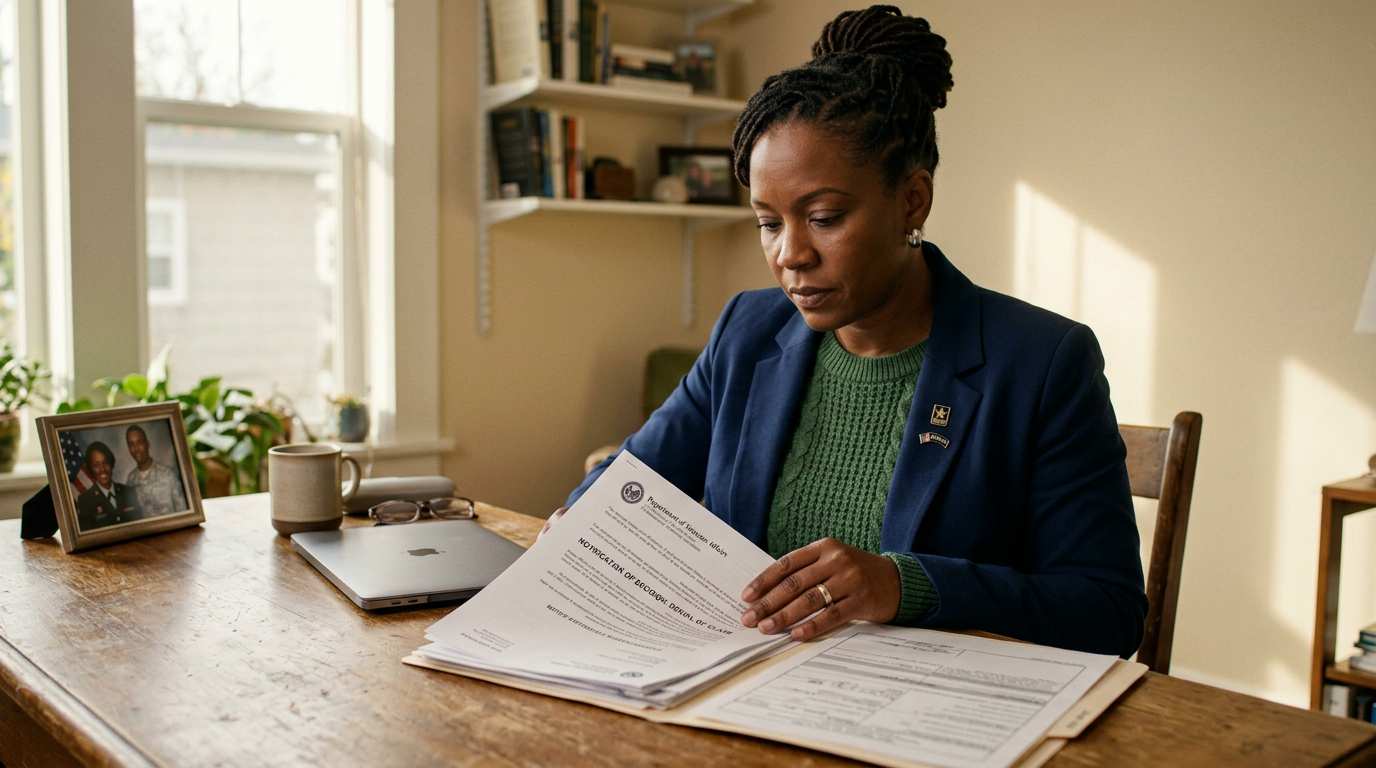
VA Claim Denied? The Four Appeal Lanes for Women Veterans
A denial is not final. Under the Appeals Modernization Act (AMA), you have four distinct paths back: Supplemental Claim, Higher-Level Review, the Board of Veterans Appeals, and — if needed — the Court of Appeals for Veterans Claims. Each lane serves a different situation, and you can move between them.
This page explains every lane in plain language, shows you which one fits your situation, and covers the denial reasons women veterans face most often — from overlooked MST markers to reproductive conditions rated under the wrong diagnostic code.
What Are the Four VA Appeal Lanes?
Yes, there are four separate paths after a denial — and choosing the right one matters. The Appeals Modernization Act (AMA), which took effect in 2019, replaced the old single-track appeals process with four independent lanes. Each lane has its own form, its own timeline, and its own rules for what evidence you can submit. Understanding the difference is the first step toward turning a denial into a grant.
Supplemental Claim
Best when: You have new and relevant evidence the VA did not consider before.
Submit VA Form 20-0995 with at least one piece of new and relevant evidence — a private medical opinion, updated treatment records, a buddy statement, or a corrected DBQ. The VA will conduct a new review from the beginning with a different rater.
For women veterans: Women veterans whose MST markers were overlooked, whose reproductive conditions were under-documented, or who now have a stronger nexus letter often win on a Supplemental Claim. A private medical opinion addressing what the C&P exam missed can be the single strongest addition.
Caution: You must submit evidence that was not in the file before. Resubmitting the same records without anything new will result in another denial.
Higher-Level Review
Best when: You believe the VA made a legal, procedural, or factual error — no new evidence needed.
Submit VA Form 20-0996. A more senior rater reviews the existing file for errors — a wrong diagnostic code, a missed secondary condition, an inadequate exam that was treated as adequate, or a failure to apply the benefit of the doubt. You can request an informal telephone conference to point out the specific error.
For women veterans: If the VA examined your MST claim under the wrong standard, applied the wrong diagnostic code to a gynecological condition, or ignored its own duty to assist under 38 CFR §3.159, a Higher-Level Review can catch and correct it without new evidence.
Caution: No new evidence is allowed at this level. If the problem is a weak record rather than a rater error, a Supplemental Claim is the better lane.
Board of Veterans Appeals (BVA)
Best when: You want a Veterans Law Judge to hear your case, especially if the regional office keeps getting it wrong.
File a Notice of Disagreement (VA Form 10182) and choose one of three dockets: the Direct Review docket (fastest, no new evidence or hearing), the Evidence docket (you can submit new evidence for 90 days), or the Hearing docket (a personal hearing before a judge, plus 90 days for evidence). A Veterans Law Judge decides your case.
For women veterans: Board hearings let you tell a judge your story directly — critical for MST claims where the evidence is personal and the markers are indirect. A judge can order a new C&P exam, something the regional office rarely does on its own.
Caution: The Board is slower than the other two lanes. Use it when a regional-office rater has repeatedly missed the point, not as the default first step.
Court of Appeals for Veterans Claims (CAVC)
Best when: The Board denied your claim, and you believe the Board made a legal error.
File a Notice of Appeal with the CAVC within 120 days of the Board decision. The Court reviews whether the Board correctly applied the law and followed its own procedures. Most cases are resolved through a Joint Motion for Remand — an agreement between you and the VA to send the case back for correction.
For women veterans: CAVC is the last resort before federal circuit court. It exists to enforce the rules the Board was supposed to follow. If the Board ignored its own precedent on MST marker evidence or applied the wrong legal standard, the Court can order a do-over.
Caution: CAVC reviews legal errors, not facts. You need an attorney (often free through pro bono programs) and must file within 120 days — there is no extension.
Which Appeal Lane Fits My Situation?
Walk through these questions in order. The first "yes" points you to the right lane.

1.Do you have new medical evidence, a new nexus letter, or a new buddy statement the VA has not seen?
2.Did the VA make a clear error — wrong diagnostic code, ignored evidence, inadequate exam treated as adequate, or failed to apply the benefit of the doubt?
3.Has the regional office gotten it wrong more than once, or do you need to tell your story to a judge (especially for MST or complex conditions)?
4.Did the Board already deny your case, and you believe the Board itself made a legal error?
Not sure? An accredited claims agent can read your denial letter and tell you which lane gives you the strongest path back. The review is free and there is no obligation. Call 702-209-5722 or request a callback below.
Why Do Women Veterans Get Denied?
The most common denial reasons are fixable. They are not a reflection of the strength of your case — they are a reflection of what was missing from the file the day the rater opened it. Here are the denials women veterans encounter most often, and what corrects each one.
No current diagnosis on file
The VA denied because no recent medical record confirms the condition still exists. Fix: get a current diagnosis from your provider and file a Supplemental Claim.
No nexus connecting condition to service
The VA says it cannot link the condition to your military service. Fix: obtain a nexus letter from a qualified medical professional who explains the connection in medical terms.
Inadequate C&P exam treated as adequate
The examiner spent five minutes, asked the wrong questions, or produced a report that contradicts the record — and the rater relied on it anyway. Fix: challenge via Higher-Level Review or submit a private medical opinion as new evidence.
MST markers overlooked
The VA did not recognize indirect evidence of military sexual trauma — behavioral changes, sudden transfers, declining performance, or counseling records. Fix: gather all available markers and file a Supplemental Claim with a statement explaining the timeline.
Wrong diagnostic code applied
The VA rated a gynecological or reproductive condition under a code that does not capture its actual severity or symptoms. Fix: request a Higher-Level Review pointing to the correct diagnostic code and criteria.
Secondary conditions not claimed
Conditions caused or aggravated by a service-connected disability — depression secondary to chronic pain, urinary issues secondary to MST-related PTSD medication — were never filed. Fix: file a new claim or Supplemental Claim for each secondary condition.
Albert Built Dedicated Sites for Other Veteran Audiences
Every site is free, informational, and run by the same accredited practice (#45147). If your situation touches one of these areas, the deep-dive is already written.
VA Benefits Calculators
Free rating calculator, back-pay estimator, and SMC tools
Visit siteThe Aging Veteran
Caregiver stipend, DIC, survivor pension, rating protection rules
Visit siteToxic Exposure Center
Era-by-era exposure maps, TERA, ILER, pushback guide
Visit siteThe VA Disability Advocate
Examiner defect review, CUE analysis, three free AI claim tools
Visit siteWhat Should I Do Right Now?
Five steps, in this order. The sooner you act after a denial, the more you protect your effective date and your back pay.
Read your decision letter carefully
The letter tells you which conditions were denied or rated, the reasons why, and the evidence the rater considered. Highlight every reason for denial — each one tells you what is missing.
File an Intent to File (VA Form 21-0966)
If you are leaning toward a Supplemental Claim, file the ITF immediately. It freezes your effective date for one year, and it takes less than five minutes.
Get a free claim review
An accredited claims agent can read your denial letter, review your evidence, and tell you which lane gives you the strongest path back. This costs you nothing and there is no obligation.
Gather the missing evidence
Depending on the lane, this may be a private nexus letter, updated medical records, buddy statements, or a DBQ from your treating physician. Match the evidence to the specific reason you were denied.
File in the right lane within one year
Submit the correct form with the right evidence in the lane that matches your situation. Protect your effective date and your back pay.

Denied or under-rated? Get a free review from someone who fights this every day.
Albert Thombs (VA-accredited claims agent #45147) will read your denial letter, tell you which lane fits, and walk you through the evidence that wins. The review is free and there is no obligation — not now, not ever.
Appeals & Denials FAQ
How long do I have to appeal a VA decision?
One year. You generally have one year from the date of the decision letter to file a Supplemental Claim, Higher-Level Review, or Board appeal. Filing within that year protects your original effective date, which directly affects back pay. After one year you can still file, but you may lose retroactive compensation.
Can I switch lanes if the first one does not work?
Yes. The Appeals Modernization Act (AMA) lets you move between lanes. If a Higher-Level Review does not fix the error, you can file a Supplemental Claim with new evidence or go to the Board. You are not locked in.
Do I need a lawyer to appeal?
No, not for most lanes — but representation helps. VA-accredited claims agents and attorneys can represent you for free during a Supplemental Claim or Higher-Level Review (the fee is contingency-based under 38 CFR §14.636, meaning you pay nothing unless you win back pay). For CAVC, an attorney is strongly recommended, and several organizations provide free legal representation.
Does filing an appeal risk losing benefits I already have?
No. Filing an appeal on a denied or under-rated claim does not put your existing service-connected ratings at risk. The VA reviews only the issue you appeal.
What is the most common reason women veterans are denied?
No current diagnosis on file or no medical nexus connecting the condition to service. Women veterans are also disproportionately affected by MST-marker evidence being overlooked and by reproductive or gynecological conditions being rated under the wrong diagnostic code.
Can I file an Intent to File before I decide which lane to use?
Yes, for a Supplemental Claim only. An Intent to File (VA Form 21-0966) freezes your effective date for one year while you gather evidence. It does not apply to Higher-Level Review or Board appeals, which have their own filing rules.
What if I missed the one-year deadline?
You can still file a Supplemental Claim at any time with new and relevant evidence, but the effective date will generally be the date of the new filing rather than the original claim date. In some cases — such as clear and unmistakable error (CUE) — earlier effective dates can be recovered.
Does Albert Thombs handle appeals for women veterans?
Yes. Albert Thombs is a VA-accredited claims agent (#45147) who specializes in appeals for veterans who were denied or under-rated, with particular experience in MST, reproductive health, and toxic-exposure claims for women veterans. The initial review is always free and there is no obligation.
Thousands of women veterans have turned a denial into a grant. The system is designed to be challenged — and the right evidence, in the right lane, wins.
Keep Going: Three Related Guides
Claims Guide
Understand direct, secondary, presumptive, and aggravation service connection.
Open guideBuilding Your Evidence
Records, lay statements, nexus letters, and DBQs — everything the file needs.
Open guideRating Calculator
Estimate what a corrected rating could mean in monthly compensation.
Open guideThis page is general educational information prepared by Albert L. Thombs Jr., a VA-accredited claims agent (accreditation #45147). It is not legal advice, not medical advice, and is not affiliated with or endorsed by the U.S. Department of Veterans Affairs or any government agency. Every timeline, dollar figure, and outcome described here is an estimate that depends on the veteran's individual circumstances and the VA's decision. Confirm all information on VA.gov or with an accredited representative.