

Maternity & Fertility Benefits
Building a family after service should never come down to what you can afford — and for women veterans, far more is covered than almost anyone realizes. The VA pays for full maternity care from your first positive pregnancy test through delivery and the year that follows, provides fertility evaluations and treatment, funds IVF for veterans whose service caused their infertility, and even reimburses adoption costs. Most women were never told any of it exists, so they assume they are on their own. You are not, and I am telling you right now so that excuse is off the table.
Everything you need is on this page, in plain English and all in one place — exactly what maternity care covers, what your Maternity Care Coordinator does for you, who qualifies for IVF and adoption reimbursement, and the part almost no one explains: when a pregnancy complication or a service-connected reproductive loss can also be worth monthly disability compensation. We even lay out the actual rating schedule so you can see the numbers yourself and run them through our calculator. You will not have to leave this page to understand your benefits.
By the Numbers
What the VA covers when you grow your family — and where the compensation side can apply, which is the part almost nobody explains. On the healthcare side, enrolled women veterans get the full course of maternity care: prenatal visits, labor and delivery, and postpartum care, delivered through community care because VA hospitals do not operate labor and delivery units. The VA pays for it, and it also covers seven days of newborn care after the birth under 38 U.S.C. §1786. On the compensation side, pregnancy itself is not a disability, but complications that arise from or are aggravated by a service-connected condition can be — and a delivery that leaves lasting damage is rated under the gynecological codes like any other injury. Every figure below comes from published VA policy and the rating regulations, not from estimates.
7 days
of newborn care covered
the VA covers care for your newborn for up to seven days after birth, on top of your own maternity care.
38 U.S.C. §1786
$0
out of pocket for maternity care
covered maternity care is delivered through VA-authorized community providers at no cost to eligible veterans.
VA Community Care
0–100%
range for pregnancy-related ratings
conditions caused or aggravated by service — including some carried through pregnancy — are rated on their impact.
38 CFR §4.116 / §4.130
1-855-829-6636
Women Veterans Call Center
call or text for maternity care coordination, enrollment, and help finding women’s health services.
VA
Maternity Care — Fully Covered
If you are enrolled in VA health care, your pregnancy care is covered from the very first positive test. Most of it is delivered through community providers close to home — you do not have to give birth at a VA hospital — and the VA coordinates and pays for it. Here is what that actually includes.
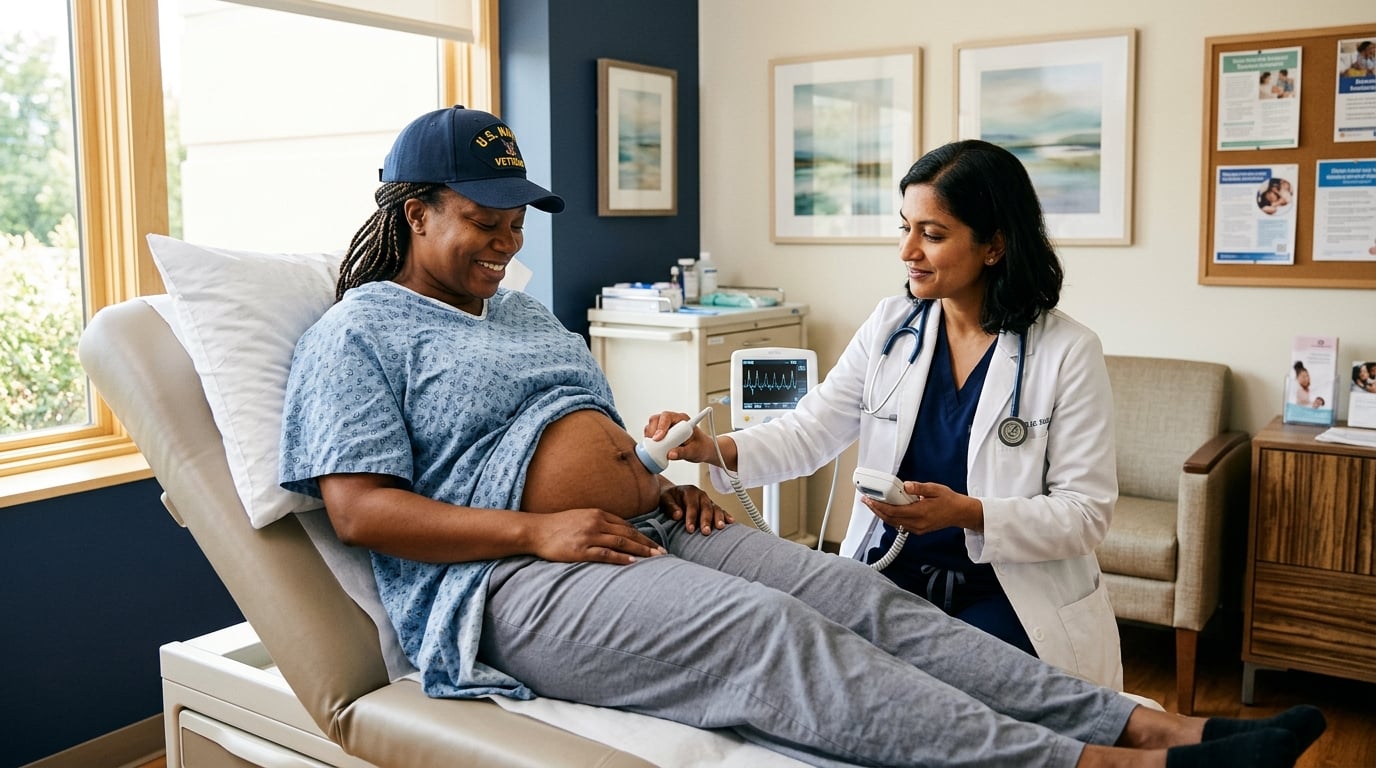
What the VA covers during pregnancy
- Full physical exams throughout your pregnancy
- Prenatal education and screening
- Laboratory tests and obstetrical ultrasounds
- Genetic testing and specialty consults
- Prescription medications and prenatal vitamins
- Labor and delivery (including C-section and anesthesia)
- Newborn care — the date of birth plus 7 consecutive days
- Mental health services during and after pregnancy
- Social work support and resource connection
- Miscarriage and stillbirth care, with compassion
Maternity supplies, covered too
- Nursing bras and nursing/lactation pads
- A breast or chest pump
- Maternity and postpartum support belts
- Human milk storage bags and nipple cream (through the VA Pharmacy)
Ask your Maternity Care Coordinator for supplies at least 6–8 weeks before your due date.
Lactation counseling is available with a reduced copay of just $15, and breastfeeding supplies are covered — so the support does not stop at delivery.
What is not covered
So there are no surprises, these fall outside VA maternity coverage:
- Home deliveries
- Services provided by a doula
- Deliveries by a lay midwife (one not trained as a registered nurse)
- Experimental or investigational procedures
Your Newborn & the Postpartum Year
The care does not end the moment you deliver. VA covers your baby's first days and, just as importantly, stays with you through the year that follows — the stretch when so many new mothers are quietly struggling and told to simply push through.
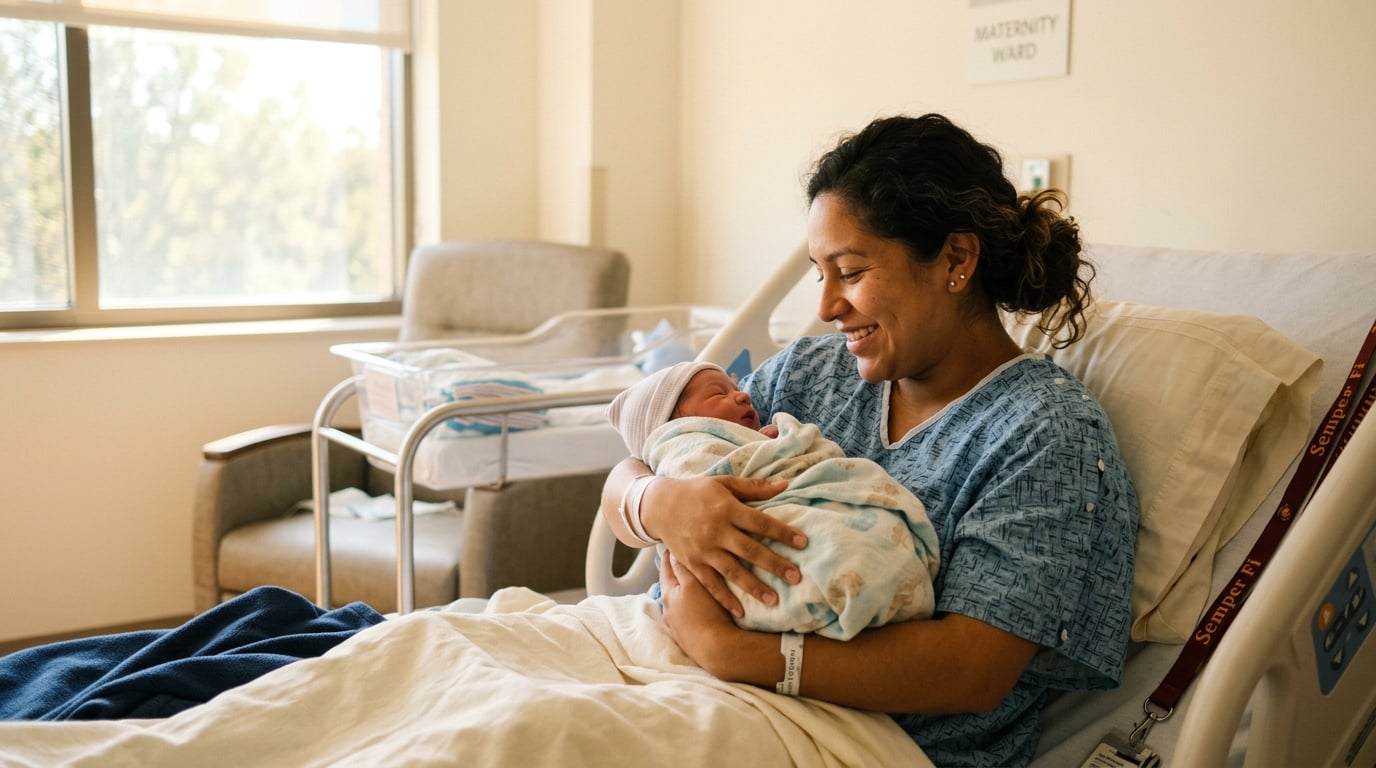
Newborn care — birth plus 7 days
The VA covers your baby's care for the date of birth plus the 7 consecutive days immediately after — the delivery, initial exams, and any care your newborn needs in that first week. Your Maternity Care Coordinator helps you line up your baby's ongoing pediatric care before you leave.

Postpartum mental health
Roughly 1 in 7 women experience postpartum depression, and the rate may be higher among veterans — especially with a history of MST or combat stress. The VA provides trauma-informed reproductive mental health care during and after pregnancy. If a perinatal mood condition is connected to your service, it can also be rated for compensation — see the schedule below.

Lactation & feeding support
Whether you breastfeed, pump, or use formula, you deserve support and no judgment. The VA covers lactation counseling (reduced $15 copay), a breast or chest pump, nursing bras and pads, milk storage bags, and nipple cream through the pharmacy. Ask your coordinator to set it up before your due date so it is ready when your baby arrives.
Your Maternity Care Coordinator
Every VA facility assigns a Maternity Care Coordinator (MCC) — a dedicated advocate on your care team who walks with you from your first positive test all the way through 12 months postpartum. She is not a clerk; she is the person who makes the system work for you.
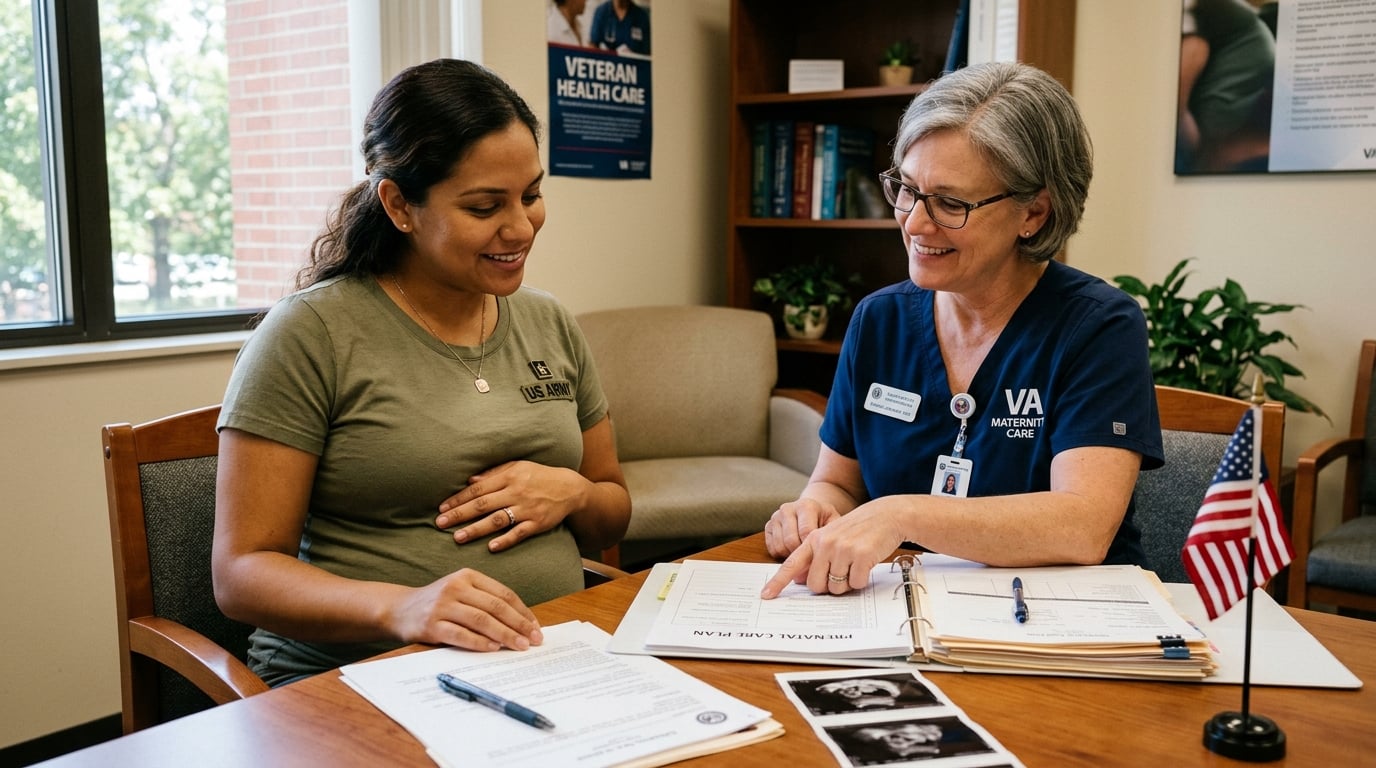
How to reach yours: Contact your VA primary care provider or your Women Veterans Program Manager, or call the Women Veterans Call Center at 1-855-829-6636 and they will connect you to the coordinator at your facility.
Fertility & IVF Benefits
There are two tiers of fertility help. Basic fertility services are open to every enrolled veteran, no service connection required. IVF is a deeper benefit reserved for veterans whose service-connected disability caused their infertility — and it was expanded dramatically in 2024.
Open to all enrolled veterans
- Fertility evaluations and counseling
- Medical history review and physical exam
- Laboratory testing
- Imaging (ultrasounds and X-rays)
- Genetic counseling
- Hormone therapies and fertility medications
- Surgical corrections (including tubal ligation reversal)
- Intrauterine insemination (IUI)
- Egg, sperm, and embryo cryopreservation (freezing)
- Referral to a community fertility specialist through VA Community Care when a service is not available in-house
These are available regardless of marital status, sexual orientation, or whether your infertility is service-connected.

IVF — Who Qualifies
Expanded March 28, 2024The March 2024 expansion — VA Secretary Instruction 01-24, effective March 28, 2024 (Federal Register 2024-07040) — opened IVF to far more veterans than before. Here is exactly where the benefit now stands:
- You must have a VA-adjudicated service-connected disability that directly causes infertility
- Marital status is no longer required — unmarried veterans and those in same-sex marriages now qualify
- If you are legally married, your lawful spouse may also be eligible for treatment
- Donor eggs, sperm, and embryos are now covered (the cost of obtaining donor material is not)
- Up to 6 attempts to create embryos, for up to 3 completed embryo-transfer cycles (lifetime benefit)
- Surrogacy is not covered by the VA under current law
The key that unlocks IVF is a VA-adjudicated service-connected disability that causes your infertility. If your infertility traces back to service and it is not yet service-connected, getting that condition rated is the first step — and it is exactly what an accredited representative can help you do.
How to access fertility care
Start with your VA primary care provider and ask for a fertility evaluation. If you are eligible for IVF, the VA refers you to a community fertility specialist to build your treatment plan. For eligibility questions, call the Women Veterans Call Center at 1-855-829-6636, or read the VA's official fertility services overview.

Adoption Reimbursement
Growing your family does not have to mean pregnancy. Veterans who qualify for the IVF benefit can also be reimbursed for the cost of adopting a child — money back for a path many families thought they would have to fund entirely alone.
Up to $2,000 per child (the child must be under age 18).
A maximum of $5,000 per calendar year if you adopt more than one child.
Available to veterans who qualify for the VA IVF benefit. Ask the Women Veterans Call Center how to submit your adoption expenses.
The Part No One Explains: When It's Also Compensation
Everything above is free medical care — a health benefit, separate from disability compensation. But there is a second track most women are never told about: when a pregnancy complication or a reproductive loss is connected to your service, it can also be worth tax-free monthly compensation. These are two different systems, and you can be in both at once.
Below are the situations that most often turn maternity and fertility issues into a ratable claim — and the actual rating language, reproduced right here so you never have to go hunting for it.
Infertility from service
Infertility itself is not a rating number — but the service-connected condition causing it (endometriosis, ovarian disease, surgical loss) is rated under §4.116. That same service-connected condition is what unlocks the IVF benefit above.
Pregnancy complications
Lasting damage from a pregnancy tied to service — such as pelvic organ prolapse from a surgical complication — carries its own rating. Conditions like gestational diabetes or high blood pressure that persist afterward may be service-connectable too.
Perinatal mental health
Postpartum depression, anxiety, or PTSD connected to service — often worsened by MST — is rated under the mental-disorders formula at §4.130. The full tiers are laid out just below.
Do not overlook Special Monthly Compensation. If a service-connected condition led to the loss of your uterus or an ovary, you may be owed SMC-K for loss of a creative organ — an extra ~$139.87 per month (2026 estimate, adjusted yearly) paid on top of your rating under 38 CFR §3.350. It is frequently missed and must usually be claimed by name.
The Rating Schedule, Spelled Out
This is the actual language the VA uses, reproduced in plain terms so you can see the numbers yourself. Read it, then take these percentages straight to our disability calculator to estimate what a rating could be worth — and to our claims guide when you are ready to file.
Gynecological Conditions — General Formula (§4.116)
The conditions behind many fertility problems — of the uterus, ovaries, cervix, and fallopian tubes — are rated on how much continuous treatment your symptoms require.
Symptoms not controlled by continuous treatment
Symptoms that require continuous treatment
Symptoms that do not require continuous treatment
Pregnancy & Surgical Loss — Set Ratings (§4.116)
Certain pregnancy complications and surgical outcomes carry their own fixed ratings, written directly into the schedule.
Pelvic organ prolapse (from injury, disease, or a surgical complication of pregnancy)
Uterus and both ovaries removed (complete) — the loss that ends fertility
Uterus removed, including corpus
Ovary removed
Source: 38 CFR §4.116. The 100% period after surgery covers recovery; the ongoing rating follows. Loss of the uterus or an ovary may also add SMC-K on top.
Perinatal & Postpartum Mental Health (§4.130)
Postpartum depression, anxiety, and PTSD connected to service are rated on the same general formula the VA uses for all mental-health conditions — based on how much your symptoms affect work and daily life.
Total occupational and social impairment
Deficiencies in most areas — work, family, mood, thinking, and judgment
Reduced reliability and productivity
Occasional decrease in work efficiency, with generally satisfactory functioning
Mild symptoms that decrease efficiency only during periods of significant stress
A diagnosis, but symptoms not severe enough to interfere with work or require medication
Source: 38 CFR §4.130. Every figure here is a starting point — an accredited representative should confirm which code and percentage truly fit your record.
If you think a claim applies to you
File an Intent to File (VA Form 21-0966) first to lock in your effective date, then submit your claim on VA Form 21-526EZ. A free VA-accredited representative can gather the records, secure a nexus opinion, and make sure Special Monthly Compensation is considered — appoint one with VA Form 21-22a, at no cost to you.
Get a free benefits reviewMaternity & Fertility, Explained
Short, trustworthy explainers straight from the VA on pregnancy care and the benefits available to you. They are worth watching for the logistics alone: how the community care referral gets authorized, why you should notify your VA maternity care coordinator as early in the pregnancy as possible, and what the VA will and will not pay for once the baby arrives. Getting that referral in place early is the difference between the VA covering your obstetrician and you fighting a bill afterward. Nothing here replaces the coverage detail on this page — it reinforces it in the VA’s own words. Watch whenever you're ready.
VA Pregnancy Care for Women Veterans
An overview from the VA of the maternity care benefit — prenatal visits, delivery through community providers, newborn coverage, and the maternity care coordinator who supports you through pregnancy and the first year after birth.
Maternity Care Benefits for Women Veterans
How your VA health benefits include maternity care, what services are covered, and how to get connected with a maternity care coordinator so nothing falls through the cracks during and after your pregnancy.
These videos are shared for general education. They are not legal advice, and watching them is never required to get help.
Maternity & Fertility Resources — Save These
Every one of these is free and confidential, and none of them require an existing rating or an open claim before you call. Tap any card to take action right now — phone numbers dial straight from your phone. The first call for anything maternity-related should be the Women Veterans Call Center at 1-855-829-6636: it is staffed entirely by women and they will connect you directly to the maternity care coordinator at your local VA, which is the person who actually authorizes your community care referral. If what you need is postpartum mental health support rather than obstetric care, the crisis line and the Vet Centers below are open to you with no diagnosis and no paperwork. Save this list on your phone now, before you need it — and pass it to a fellow veteran who would never ask for it herself.
Your Family — and Your Benefits — Are Worth Fighting For
Whether you are planning a pregnancy, growing your family through IVF or adoption, or realizing a service-connected loss may be owed compensation — you do not have to figure it out alone. Get your care, and let someone who does this every day make sure nothing you earned is left on the table.
Questions Women Ask About Maternity Care
Clear answers about what the VA covers before, during, and after birth — and where the compensation side can apply. A free review can tell you how these rules fit your situation.
Does the VA cover my maternity care?
Yes. If you are enrolled in VA health care, your maternity care — prenatal visits, delivery, and postpartum care — is covered, generally through a VA-authorized community OB/GYN close to you. Covered care is provided at no cost to eligible veterans, and a Maternity Care Coordinator helps manage the details.
Is my newborn covered after delivery?
Yes, for a limited time. The VA covers medically necessary care for your newborn for up to seven days after birth. Your Maternity Care Coordinator can walk you through what is included and help you plan for your baby’s care after that window.
What if I experience postpartum depression or anxiety?
The VA covers mental health care, including for postpartum depression and anxiety. These are common and treatable, and seeking care does not count against you. If symptoms are tied to or worsened by a service-connected condition, they may also be relevant to a disability claim.
Can pregnancy-related conditions ever be service-connected?
Sometimes. A condition that was caused or aggravated by your service — or a service-connected condition that complicates pregnancy — may be rated under the VA’s rules (38 CFR §4.116 and §4.130). It is worth a free review to see whether anything you are dealing with should be on a claim.
Does the VA help with fertility treatment or IVF?
The VA covers a range of infertility evaluations and treatments, and in defined circumstances covers IVF — particularly where a service-connected condition affects fertility. Eligibility is specific, so confirm your situation rather than assuming you do not qualify.
Who do I call to set all this up?
Start with the Women Veterans Call Center at 1-855-829-6636 (call or text) or ask your VA care team for the Maternity Care Coordinator. For the claims side, an accredited claims agent can review your situation for free.
Still have a question about your own situation?