
For Women Veterans
Aging & Senior Benefits
Social Security, Medicare, elder law, patient rights, and every 800 number you need — cut through the rumors and understand exactly what you are entitled to as you age.
Understanding Your Coverage
Medicare, Social Security & VA Benefits
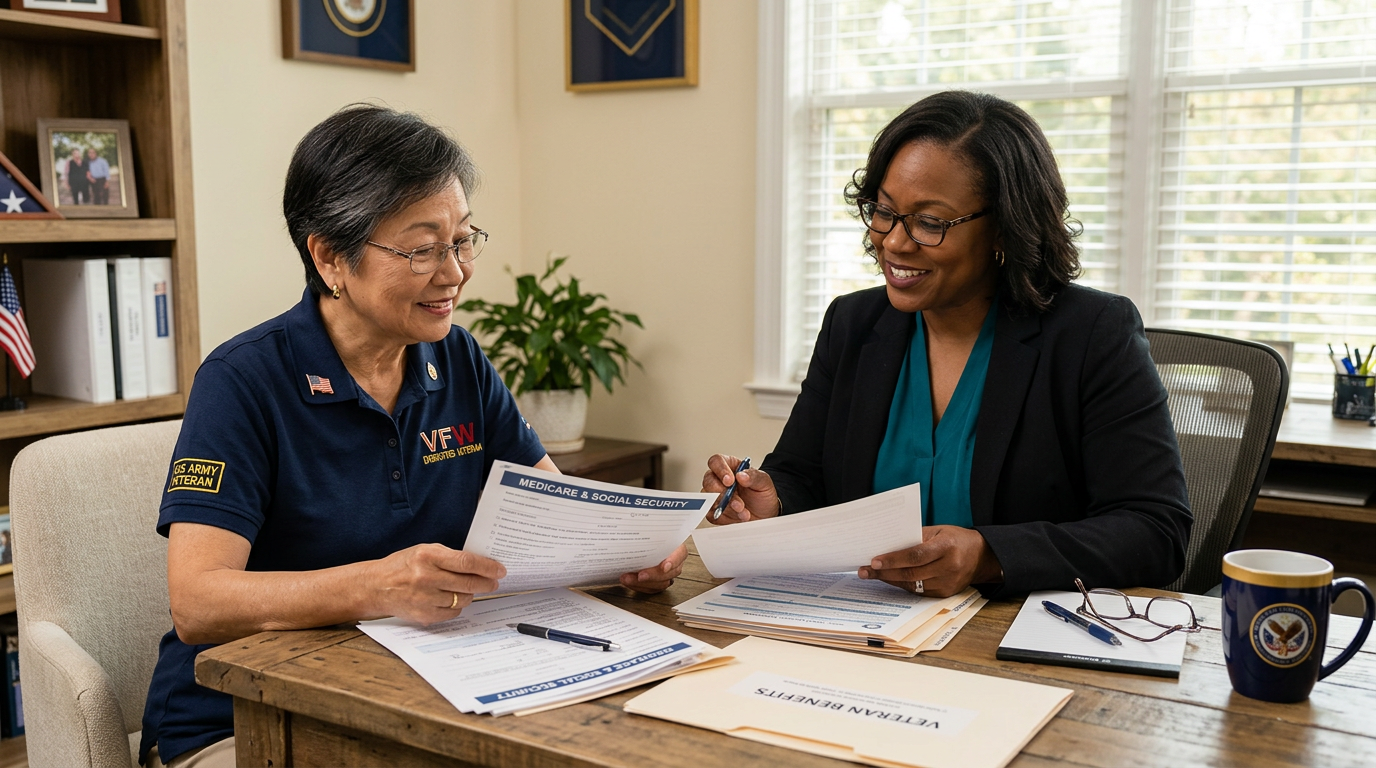
Here is the reality: Medicare and VA healthcare are two completely separate systems. They do not talk to each other, they do not coordinate payments, and making the wrong choice about enrollment can cost you thousands in permanent penalties. You need to understand how they work together so you can make the right decision for your situation.
2026 Medicare Costs at a Glance
The Bottom Line for Women Veterans
- Part A — enroll at 65. Usually free if you or your spouse paid Medicare taxes for 10+ years. Covers hospital stays at civilian facilities. No penalty for late enrollment, but no reason to skip it.
- Part B — enroll at 65 or face a permanent penalty. Costs $202.90/month in 2026. Covers doctor visits, outpatient care, labs, and specialists outside the VA. VA coverage does NOT exempt you from the late-enrollment penalty. Every 12 months you delay adds a 10% premium surcharge for life.
- Part D — you can skip it. VA prescription drug coverage IS creditable for Part D. If you use the VA pharmacy, you can delay Part D without penalty. This is the one exception.
- CHAMPVA families — Part B is required. If your dependents get CHAMPVA benefits, they MUST have Medicare Part B to keep CHAMPVA coverage. This catches a lot of families off guard.
- Social Security does not offset VA disability. You can collect both VA disability compensation AND Social Security retirement (or SSDI) simultaneously — they do not reduce each other.
Social Security Enrollment
Call 1-800-772-1213 (TTY: 1-800-325-0778) or visit ssa.gov. Available Monday–Friday 8am–7pm local time. You can apply for Social Security retirement benefits online starting at age 62, and Medicare enrollment at 65.
Cutting Through the Noise
Medicare & VA — Myths vs Facts
These are the rumors that circulate in every veteran community. Some are flat wrong, one is actually right. Know the difference before it costs you.
Myth
"If I have VA healthcare I don't need Medicare."
Fact
VA healthcare is excellent, but it is NOT considered "creditable coverage" for Medicare Part B. If you skip Part B enrollment when you turn 65, you'll pay a permanent 10% premium penalty for every 12 months you delayed. That penalty never goes away and it compounds — five years late means 50% higher premiums for life. Enroll in Part A (usually free) the month you turn 65, and seriously consider Part B even if you use the VA for everything.
Myth
"Medicare will pay my VA copays."
Fact
Wrong. The VA and Medicare are two completely separate systems. Medicare does not pay any copays, deductibles, or coinsurance for care received at VA facilities, and the VA does not pay for costs incurred under Medicare. When you walk into a VA clinic, you use your VA benefits. When you walk into a civilian provider, you use Medicare. You cannot mix them on the same visit.
Myth
"I'm 100% P&T — I don't need anything else."
Fact
Being rated 100% Permanent & Total gives you no-cost VA healthcare, but it doesn't replace Medicare. P&T does not exempt you from the Part B late-enrollment penalty. And if you ever need to see a specialist who is not in the VA system — a private orthopedic surgeon, a dermatologist in your town, a rural ER — Medicare is what covers you there. P&T also qualifies your dependents for CHAMPVA, and CHAMPVA beneficiaries MUST have Medicare Part B to keep CHAMPVA coverage.
Myth
"VA drug coverage counts for Medicare Part D, so I can skip Part D."
Fact
This one is actually true. VA prescription drug coverage IS considered creditable coverage for Part D, so you can delay enrolling in a standalone Part D plan without facing a late-enrollment penalty. This is the one exception — Part A and Part B penalties still apply, but Part D does not. If you rely on the VA pharmacy, you're fine on Part D.
Free Legal Help
Senior Law Projects & Legal Aid
You have legal rights — and there are people who will represent you for free. Senior Law Projects and Veterans Law Projects exist in every state to help with VA claims, appeals, discharge upgrades, housing disputes, estate planning, and protection from financial exploitation. Here is how to find one.
Eldercare Locator
The U.S. Administration on Aging's free service connects you to local legal aid, Area Agencies on Aging, elder-law attorneys, and community services in your county. They maintain a searchable database of every senior-service provider in the country.
VA Legal Services — Office of General Counsel
The VA's own legal-services page lists free legal clinics, pro bono attorneys, and law-school clinics that specialize in veterans' benefits appeals, discharge upgrades, housing law, and estate planning. Many VA Medical Centers host monthly legal clinics in partnership with local bar associations.
Stateside Legal
A free legal-resource finder specifically for service members, veterans, and their families. Enter your zip code and legal issue, and it matches you with pro bono attorneys and legal-aid organizations in your area that handle veterans' cases.
Your Local Legal Aid Society — Veterans Law Project
Most states have a Legal Aid Society or Legal Services Corporation office with a dedicated Veterans Law Project. These provide free representation in VA claims and appeals, discharge upgrades (especially for MST-related discharges), housing disputes, consumer debt, and family law. Search your state's Legal Aid website or call your local VA social worker for a warm referral.

What Senior Law Projects Typically Handle
- VA claims and BVA appeals
- Military discharge upgrades (especially MST-related)
- Landlord-tenant disputes & eviction defense
- Estate planning — wills, advance directives, powers of attorney
- Protection from financial exploitation and predatory lending
- Consumer debt, identity theft, and fraud recovery

You Are Not Alone
Elder Abuse — Know the Signs, Know the Numbers
Elder abuse takes many forms — physical, emotional, financial exploitation, neglect, and abandonment. It happens to veterans of every background, and it is drastically underreported. If something feels wrong, you have the right to report it. These hotlines exist specifically to protect you.
Eldercare Locator — Abuse Reporting
Connects you to your local Adult Protective Services (APS) agency. APS investigates reports of abuse, neglect, and exploitation of older adults. Available Monday–Friday; interpreters available in 150+ languages.
1-800-677-1116National Elder Fraud Hotline
Operated by the U.S. Department of Justice for financial exploitation and scams targeting seniors — phone scams, identity theft, pension fraud, predatory lending. Case managers walk you through the reporting process and connect you with recovery resources. Monday–Friday 10am–6pm ET.
1-833-372-8311National Domestic Violence Hotline
For veterans experiencing domestic violence or intimate partner violence at any age. Trained advocates available 24/7. The VA also has Intimate Partner Violence (IPV) Coordinators at every VA Medical Center — ask your social worker.
1-800-799-7233Adult Protective Services (APS)
Every state operates its own APS office for reporting suspected abuse, neglect, or exploitation. If you suspect someone is being harmed, APS will investigate. Call the Eldercare Locator (1-800-677-1116) to find your state's specific APS reporting number. In an emergency, always call 911.
Call Eldercare Locator (1-800-677-1116) for your state\'s number
If you or someone you know is in immediate danger, call 911.
For a mental health crisis, call the Veterans Crisis Line: 988 (press 1) or text 838255.
Your Voice Matters
The Patient Advocate Office
Every VA Medical Center has a Patient Advocate — and most veterans have no idea they exist. The Patient Advocate is there to resolve your concerns about scheduling, quality of care, staff behavior, facility conditions, billing, and anything else that is not right. You have recourse. You do not have to just take it.
How to Reach Your Patient Advocate
- 1 Call your VA Medical Center\'s main phone number and ask for the Patient Advocate\'s office.
- 2 Or call MyVA411: 1-800-698-2411 and they will route you directly.
- 3 Walk into the Patient Advocate\'s office — it is usually in the main building of your VA Medical Center.
- 4 If your concern is about fraud, waste, or systemic misconduct, escalate to the VA Inspector General Hotline: 1-800-488-8244.
What Patient Advocates Handle
- Appointment scheduling problems
- Quality of care concerns
- Unprofessional staff behavior
- Billing and copay disputes
- Facility conditions and accessibility
- Community care coordination problems
When It Is More Than a Patient Advocate Issue
If your concern involves fraud, systemic abuse, employee misconduct, or a pattern that the Patient Advocate cannot resolve, contact your U.S. Representative or Senator to open a formal Congressional Inquiry. Congressional staff can compel a response from the VA within defined timeframes. You can also file directly with the VA Office of Inspector General at 1-800-488-8244.
Save These Numbers
The 800 Numbers Every Aging Veteran Needs
These are the numbers that cut through the bureaucracy and connect you directly to the people who can help. Save them in your phone. Share them with your family. The most important call you make is the one you actually dial.
MyVA411 — VA Information Line
1-800-698-2411The single front door to the entire VA system. They will route you to any VA office, answer general questions, connect you to your local Patient Advocate, and help you navigate the bureaucracy. Available 24/7.
Veterans Crisis Line
988 (press 1)Immediate mental health crisis support, 24/7/365. Also available by text (838255) or chat (VeteransCrisisLine.net). Trained responders connect you with local crisis resources and coordinate with your VA care team. You do not have to be enrolled in VA healthcare to use this service.
VA Health Benefits Hotline
1-877-222-8387Enrollment, eligibility, copay questions, appointment scheduling, travel reimbursement, and anything related to your VA health benefits. Monday–Friday 8am–8pm ET.
VA Inspector General Hotline
1-800-488-8244For reporting fraud, waste, abuse, or serious misconduct within the VA. The OIG investigates and protects whistleblowers. If something is systemically wrong — not just a scheduling issue — this is where you report it. Anonymous reports accepted.
National Elder Fraud Hotline
1-833-372-8311Financial exploitation, phone scams, identity theft targeting older veterans. Operated by the Department of Justice. Case managers assigned to every caller.
Eldercare Locator
1-800-677-1116Connects you to local elder services — legal aid, senior centers, Meals on Wheels, transportation, caregiver support, and Adult Protective Services for your area.
VA Caregiver Support Line
1-855-260-3274For caregivers of aging veterans — respite care, stipend programs (PCAFC), training, and emotional support. Monday–Friday 8am–10pm ET, Saturday 8am–5pm ET.
Social Security Administration
1-800-772-1213Retirement benefits, disability (SSDI/SSI), Medicare enrollment, replacement cards, and survivor benefits. Monday–Friday 8am–7pm local time. TTY: 1-800-325-0778.
Not Sure Where to Start?
The benefits landscape gets more complex as you age — Medicare, Social Security, long-term care, legal protections. We will review your situation and make sure you are not leaving anything on the table.
Common Questions
Frequently Asked Questions
Do I need Medicare if I already have VA healthcare?
The VA strongly recommends it. VA healthcare is excellent, but Medicare Part A is usually free and Part B protects you from a permanent late-enrollment penalty. If you ever need to see a civilian provider — an ER in your town, a specialist not available at the VA — Medicare is what covers you. Without Part B, you pay 100% out of pocket for anything outside the VA system.
What is the Part B late-enrollment penalty?
If you do not enroll in Medicare Part B during your Initial Enrollment Period (the 7-month window around your 65th birthday), you pay a permanent 10% premium surcharge for every 12-month period you delayed. This penalty never goes away and is added to your monthly premium for life. Five years late = 50% higher premiums forever.
How do I find a Patient Advocate at my VA?
Call your VA Medical Center's main number and ask for the Patient Advocate's office, or call MyVA411 at 1-800-698-2411 and they will connect you. Every VA health care facility has a designated Patient Advocate. You can also visit the Patient Advocate office in person — it is typically located in the main building of your VA Medical Center.
What does a VA social worker do?
VA social workers connect you with benefits, community resources, housing assistance, financial counseling, caregiver support, and mental health services. They help navigate the VA system, coordinate care, and advocate for your needs. Ask your primary care provider for a referral, or call your VA facility and request to speak with social work directly.
How do I report elder abuse or financial exploitation?
Call the Eldercare Locator at 1-800-677-1116 to reach your local Adult Protective Services. For financial fraud or scams, call the National Elder Fraud Hotline at 1-833-372-8311. In an emergency, always call 911. If the abuse involves a VA employee or VA facility, also contact the VA Inspector General Hotline at 1-800-488-8244.
What is the Senior Law Project and how do I find one?
Many states operate Senior Law Projects or Veterans Law Projects through their local Legal Aid societies. These provide free legal help with VA claims, appeals, discharge upgrades, housing issues, estate planning, and consumer protection. Use the Eldercare Locator (1-800-677-1116), Stateside Legal (statesidelegal.org), or the VA legal services page (va.gov/ogc/legalservices.asp) to find one near you.
Can I use both the VA and Medicare for the same condition?
Not on the same visit. You choose which card to use each time you seek care. At a VA facility, you use VA benefits. At a civilian provider, you use Medicare. They do not coordinate payments — you cannot bill Medicare for a VA copay or vice versa. However, having both gives you maximum flexibility: VA for specialized veteran care, Medicare for local civilian providers.
Does my VA disability rating affect my Social Security?
VA disability compensation and Social Security are completely separate programs. You can receive both simultaneously — they do not offset each other. Your VA rating has no impact on your Social Security retirement amount, and Social Security does not reduce your VA compensation. If you are also receiving SSDI (Social Security Disability), both VA disability and SSDI can be paid together.
Find Your VA Social Work Leader
Every VA health care system has a designated Social Work Leader. They can connect you with the right social worker for your specific needs. Visit theVA Social Work Leaders Directory to find yours by state.
Your Navigator Through the System
VA Social Workers
VA social workers are your navigators through the entire system — benefits, housing, financial counseling, caregiver support, mental health services, community resources, and crisis intervention. They advocate for your needs and connect you with services you may not even know exist. You do not need a referral to ask for help.
How to Connect
What Social Workers Help With