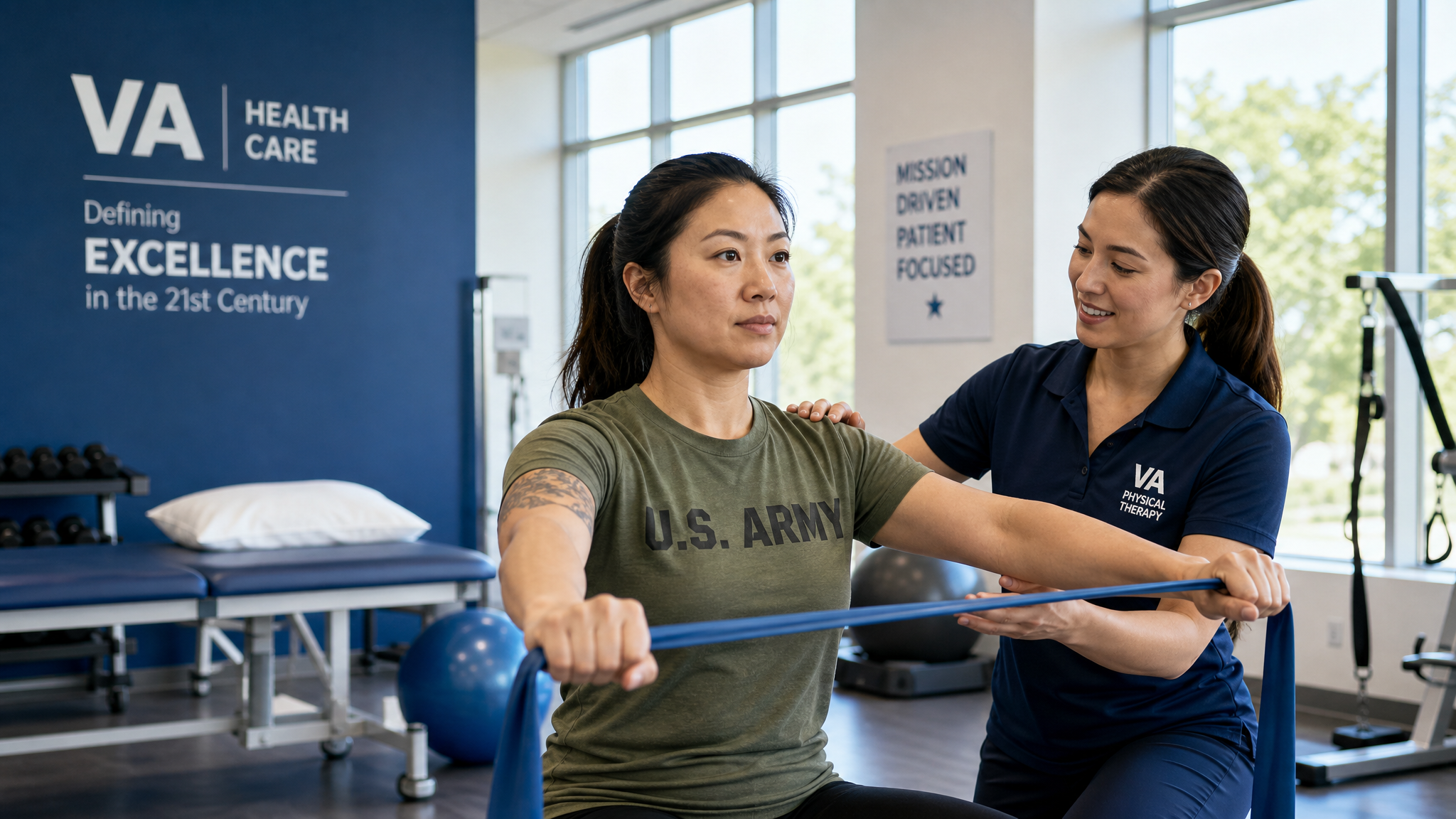
Specialty & Surgical Care for Women Veterans
Cardiology, orthopedics, dermatology, audiology, vision, dental care, prosthetics, pain management, and post-surgical support — the specialist services the VA provides.
When your health needs go beyond what primary care can handle, the VA has a full spectrum of specialty and surgical services — orthopedics, cardiology, dermatology, audiology, vision, dental, pain management, and gynecological surgery. These are not stripped-down versions of civilian care; the VA is the largest integrated health system in the country and handles complex cases every day.
Most specialty care starts with a referral from your primary-care provider. If the VA cannot provide a specific service at your facility within travel and wait-time standards, it is required to arrange it through Community Care — a local, non-VA specialist at no additional cost to you.
Women-specific specialty care — gynecological procedures, post-mastectomy prosthetics, pelvic-floor therapy — is part of the system, and your Women's Health Primary Care Provider coordinates referrals into these areas seamlessly.
Beyond primary care
Cardiology, orthopedics, dermatology, audiology, vision, dental care, prosthetics, pain management, and post-surgical support — the specialist services the VA provides.
Use the eligibility and access steps on this page to connect with this service without leaving the guide.
Understanding Specialty & Surgical Care
Gynecological surgery
Procedures for endometriosis, fibroids, ovarian cysts, and other conditions requiring surgical intervention — from minimally invasive laparoscopy to complex procedures. Arranged at your VA facility or through Community Care when needed.
Orthopedics and physical therapy
Treatment for the musculoskeletal injuries common after service — back, knee, hip, shoulder, and joint conditions. Orthopedic surgery, physical therapy, and chiropractic care are all available.
Cardiology
Cardiac evaluation, stress testing, echocardiography, and treatment for heart disease — including ongoing monitoring for women with service-connected hypertension or cardiovascular conditions.
Pain management
A whole-person approach to chronic pain that goes beyond medication: physical therapy, acupuncture, chiropractic care, nerve blocks, and behavioral pain management strategies.
Audiology and vision
Hearing tests, hearing aids, cochlear implant evaluation, routine eye exams, glasses, and treatment for eye conditions. Hearing aids and glasses are provided and maintained by the VA.
Post-mastectomy and prosthetic services
After breast cancer surgery, the VA provides breast prostheses, mastectomy bras, and related supplies, plus reconstruction options. Prosthetic limbs, sensory aids, and assistive devices are fitted and maintained for service-connected conditions.
Do you qualify for Specialty & Surgical Care?
You are enrolled in VA health care and have a referral from your primary-care team for the specialty service needed.
Service-connected conditions generally receive priority access to specialty care, including no copays.
Non-service-connected conditions may involve copays depending on your priority group, but the care is still available.
Dental care eligibility is more limited — full dental benefits are available to veterans with 100% disability, former POWs, and certain other categories. All veterans can receive emergency dental treatment.
Prosthetic devices and assistive aids are provided for service-connected conditions and certain other eligible categories.
If your VA facility cannot provide a specialty service within access standards, Community Care arranges it with a local provider at no additional cost.
Not sure whether you qualify? Eligibility details can be complex. An accredited representative can confirm exactly where you stand before you invest time in applications.
What Specialty & Surgical Care actually gives you
Orthopedic surgery and rehabilitation
Joint replacement, spinal surgery, rotator cuff repair, and post-surgical physical therapy — the musculoskeletal conditions that affect women veterans at high rates.
Cardiology and heart health
Cardiac testing, treatment, and ongoing monitoring — particularly important for women with service-connected hypertension or PACT Act cardiovascular conditions.
Dermatology
Skin conditions, surgical removal of lesions, burn-pit-related skin concerns, and ongoing monitoring for skin cancer in veterans with toxic exposure history.
Hearing aids and audiology
Comprehensive hearing evaluation, hearing aids provided and maintained at no cost for eligible veterans, and cochlear implant assessment.
Vision care and eyeglasses
Routine eye exams, prescription glasses, and treatment for eye conditions — including monitoring for conditions connected to toxic exposure or TBI.
Dental care (eligibility-dependent)
Comprehensive dental for 100% disabled veterans and certain other categories. Emergency dental care for all enrolled veterans. Dental insurance (VADIP) for all enrolled veterans at reduced cost.
What this means for you
Women veterans are more likely than their male counterparts to need specialty care that the VA historically did not prioritize — gynecological surgery, pelvic-floor therapy, and post-mastectomy support. These services are now part of the system, but you may need to advocate for yourself or ask your WH-PCP to push the referral. If you are told a service is "not available," ask specifically about Community Care — the VA is required to send you to a civilian specialist when it cannot provide the care itself.
Getting Specialty & Surgical Care, step by step
Start with your primary-care provider
Most specialty care begins with a referral from your WH-PCP or primary-care team. Tell your provider what you are experiencing and they will order the right referral.
Ask about wait times
If the wait for a specialty appointment exceeds VA access standards (generally 20 days for existing patients, 28 days for new), you may be eligible for Community Care with a non-VA specialist.
Request Community Care if needed
If your VA does not offer the specialty or the wait is too long, ask your provider or patient advocate to submit a Community Care referral. The care is arranged at no additional cost to you.
For dental, check your eligibility category
Full dental benefits depend on your disability rating and other factors. Visit the VA dental eligibility page or ask your patient advocate which dental services you qualify for.
For prosthetics or assistive devices, contact the Prosthetics department
Your VA medical center's Prosthetics department handles evaluation, fitting, and ongoing maintenance for prosthetic limbs, hearing aids, glasses, breast prostheses, and other assistive devices.
Women Veterans Call Center
For specialty care access, referral questions, and Community Care eligibility
1-855-829-6636What trips women veterans up
Assuming the VA does not do surgery — the VA performs complex surgical procedures every day, from joint replacement to gynecological and cardiac surgery.
Not asking about Community Care when wait times are long — if you are waiting more than 20-28 days for a specialist, you may be eligible to see a local provider at no cost.
Missing dental eligibility — many women do not realize that 100% disability unlocks full dental care, or that VADIP dental insurance is available to all enrolled veterans at reduced cost.
Not mentioning service-connected conditions at specialty visits — service connection affects your copay obligations and priority access.
Ignoring chronic pain until it becomes disabling — the VA's pain management approach combines multiple non-drug options with medication, and early intervention prevents escalation.
Forgetting about prosthetic services — hearing aids, glasses, breast prostheses, and assistive devices are provided and maintained by the VA for eligible veterans.
Specialty & Surgical Care: your questions answered
How do I get a referral to a specialist?
Start with your primary-care provider. They will evaluate your condition and, if specialty care is needed, submit a referral to the appropriate VA department or to Community Care if the service is not available at your facility.
What if the wait for a specialty appointment is too long?
VA access standards are generally 20 days for existing patients and 28 days for new patients. If your facility cannot meet those standards, you may be eligible for Community Care — a non-VA specialist at no additional cost. Ask your provider or patient advocate.
Does the VA provide dental care?
Full dental benefits are available to veterans rated 100% disabled, former POWs, veterans with service-connected dental conditions, and certain other categories. All enrolled veterans can access emergency dental care. The VA Dental Insurance Program (VADIP) is available to all enrolled veterans at reduced cost.
Are hearing aids free?
For eligible veterans — including those with service-connected hearing loss — the VA provides hearing aids at no cost, including batteries and maintenance. Your audiology department handles evaluation and fitting.
Can I get a second opinion on a specialist recommendation?
Yes. You have the right to request a second opinion from another VA specialist or, in some cases, through Community Care. Talk to your primary-care provider or patient advocate.
What is pelvic-floor therapy and does the VA offer it?
Pelvic-floor therapy treats bladder control, pelvic pain, and other conditions through specialized physical therapy. The VA offers it at many facilities, and if yours does not, Community Care can arrange it with a local provider.
See every healthcare service available to women veterans, or estimate the rating that could expand your VA health care access.
Not sure where to start?
Whether you need help enrolling, understanding what the VA covers, or connecting a health condition to a disability claim, a free review of your situation can put you on the right path.