
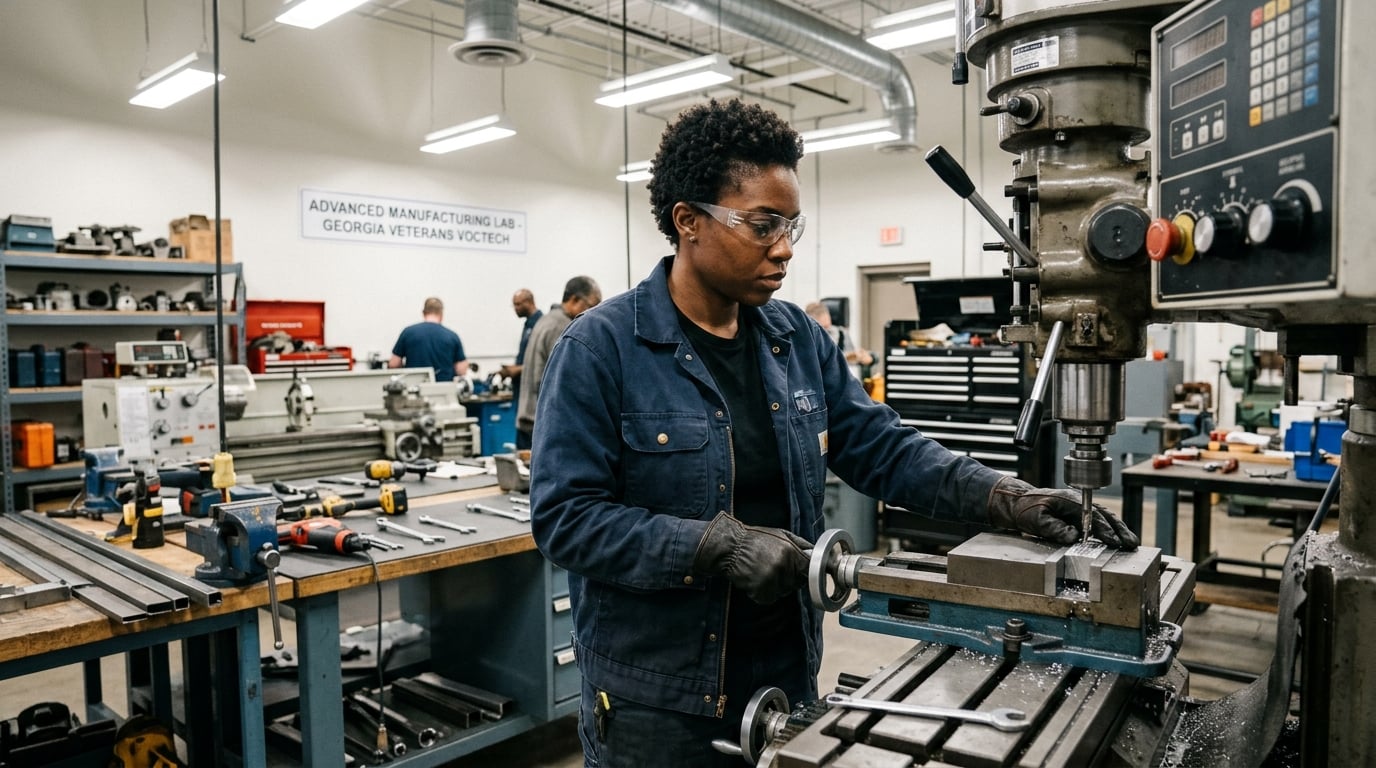
Vocational Rehabilitation & Employment (VR&E / Chapter 31)
If your service-connected disability makes it harder to work, VR&E will pay for the training, tools, and support you need to build a career that works with your body and your life — not against it.
Vocational Rehabilitation and Employment — now officially branded as VetSuccess — is the VA benefit that does not just pay for school; it pays for whatever you need to build a sustainable career around a disability that changed the rules on you.
If your service-connected condition makes it harder to get or keep a job, VR&E provides education and training (college, trade school, certifications, on-the-job training), all the supplies and tools for your new field, a monthly subsistence allowance while you train, a dedicated VR&E counselor who stays with you the entire time, and job-placement assistance when you finish.
What makes VR&E different from the GI Bill is the scope: it is not just tuition money. Your counselor can authorize adaptive equipment, assistive technology, resume services, interview preparation, child care assistance, and even self-employment support if your disabilities make traditional employment impractical. The mission is to get you into a career, not just through a degree.
For the veteran
If your service-connected disability makes it harder to work, VR&E will pay for the training, tools, and support you need to build a career that works with your body and your life — not against it.
Use the eligibility, payment, and application steps on this page to understand this benefit without leaving the guide.
What This Benefit Is
A full career-rebuilding program, not just tuition
VR&E covers everything in the path from "I can't do what I used to do" to "I have a career that works for me." That includes assessments to identify your strengths and barriers, a personalized rehabilitation plan, payment of tuition and fees, books and supplies, tools of the trade, adaptive technology, and a monthly living stipend while you train.
Five service tracks
VR&E offers five tracks depending on your situation: (1) Reemployment — if you can return to your old job with accommodations; (2) Employment through Long-Term Services — new degree or training for a new career; (3) Rapid Access to Employment — fast-track job placement; (4) Self-Employment — business startup support; (5) Independent Living — for those whose disabilities are too severe for traditional employment. Most women veterans use Track 2 (education) or Track 4 (self-employment).
A dedicated counselor the whole way
Every VR&E participant is assigned a vocational rehabilitation counselor (VRC) — a trained professional who develops your rehabilitation plan with you, authorizes services, tracks your progress, and connects you with employment when you graduate. Think of them as your advocate inside the VA system.
Up to 48 months (and sometimes more)
VR&E generally provides up to 48 months of training — 12 months more than the GI Bill. Extensions beyond 48 months are possible when the rehabilitation plan requires it. If you have both VR&E eligibility and GI Bill eligibility, you can use VR&E without burning your GI Bill months (they are separate entitlements).
Who Qualifies
You have a service-connected disability rating of at least 10% from the VA.
You received a discharge that is other than dishonorable.
You have an employment handicap — meaning your service-connected disability creates a barrier to getting, keeping, or advancing in a job suited to your abilities and interests.
Veterans rated 20% or higher are presumed to have an employment handicap — you do not have to prove it separately.
You apply within 12 years of your VA disability rating notification (extensions are available for serious employment handicaps).
You can be eligible for VR&E even if you are also eligible for the Post-9/11 GI Bill — using VR&E does not consume your GI Bill months.
What It Covers
Tuition, fees, books, and supplies
The VA pays the school directly for all tuition and fees, and provides all required books, supplies, and course materials at no cost to you.
Monthly subsistence allowance
A monthly living stipend while you train — the rate depends on your training type and whether you are full-time or part-time. It is comparable to the GI Bill housing allowance.
Tools of your new trade
If your new career requires tools, equipment, uniforms, or technology, VR&E purchases them for you. This can include laptops, medical equipment, construction tools, or anything else your counselor approves for your plan.
Adaptive technology and accommodations
Assistive technology, workplace modifications, and disability-related accommodations needed for your training or job.
Job placement and post-employment support
Your VRC helps you find a job when you finish training — resume, interview prep, employer connections. And VR&E can continue supporting you for up to 60 months after placement to make sure the job sticks.
Self-employment startup
If traditional employment is not feasible due to your disabilities, VR&E can fund business plans, equipment, supplies, and licensing for a viable self-employment path.
How to Apply
Confirm your service-connected disability rating
You need a VA disability rating of at least 10%. If you do not have one, start with a disability claim — a free representative can help you file.
Apply online with VA Form 28-1900
Submit your application at VA.gov. You can also apply in person at your nearest VA regional office. Processing typically takes 1–2 weeks.
Meet with a Vocational Rehabilitation Counselor (VRC)
Your assigned VRC will evaluate your employment handicap, discuss your career goals, and develop a personalized rehabilitation plan with you.
Begin your plan
Once your rehabilitation plan is approved, you start training, education, or employment services. Your VRC stays with you throughout the process and authorizes services as needed.
For women veterans
VR&E is one of the most underused benefits among women veterans — and one of the most valuable. If MST, PTSD, chronic pain, or any other service-connected condition is making it hard to hold a job, VR&E does not just pay for school; it builds a career path around your real limitations. If traditional employment is out, Track 4 (self-employment) has helped women veterans start businesses from home. You do not have to white-knuckle your way through a job that is destroying you.
Mistakes That Cost Families the Most
Not knowing you can use VR&E and the GI Bill — they are separate entitlements. Using VR&E does not burn your GI Bill months.
Settling for a rehabilitation plan that does not reflect your real goals — your VRC works with you, not over you. Speak up about what you actually want to do.
Letting the 12-year application deadline pass — if you are outside the window, apply anyway. The VA grants extensions for serious employment handicaps.
Thinking VR&E is only for physical disabilities — MST-related PTSD, depression, TBI, anxiety, and other mental health conditions all qualify.
Not asking about self-employment — Track 4 is a real option if your disabilities make a 9-to-5 impractical.
Frequently Asked Questions
Can I use VR&E if I already used my GI Bill?
Yes. VR&E is a separate entitlement. Even if you have exhausted your GI Bill months, you can still qualify for up to 48 months of VR&E if you have an employment handicap from a service-connected disability.
What is the monthly subsistence allowance?
The amount varies by training type and enrollment status. For full-time training at a college, the rate is comparable to the GI Bill housing allowance (E-5 BAH). Your VRC will provide exact figures for your plan.
Can VR&E pay for a graduate degree?
Yes — if your rehabilitation plan calls for a graduate degree to achieve your career goal, VR&E will cover it. The decision is made with your VRC based on what your career path requires.
What if I am already employed but want to change careers?
If your service-connected disability is making your current job unsustainable, you may still qualify. The employment handicap evaluation considers whether you can maintain suitable employment, not just whether you currently have a job.
How is VR&E different from the GI Bill?
The GI Bill pays for school. VR&E pays for school AND provides a counselor, career planning, adaptive technology, job placement, and post-employment support — it is a full career-rebuilding program, not just tuition money. VR&E also covers up to 48 months versus the GI Bill's 36.
VR&E (Chapter 31) — Official VA Links
Everything is explained on this page. These official links take you straight to the source.
VR&E Hotline
1-800-827-1000Ask for Vocational Rehabilitation — they will connect you with your regional office