
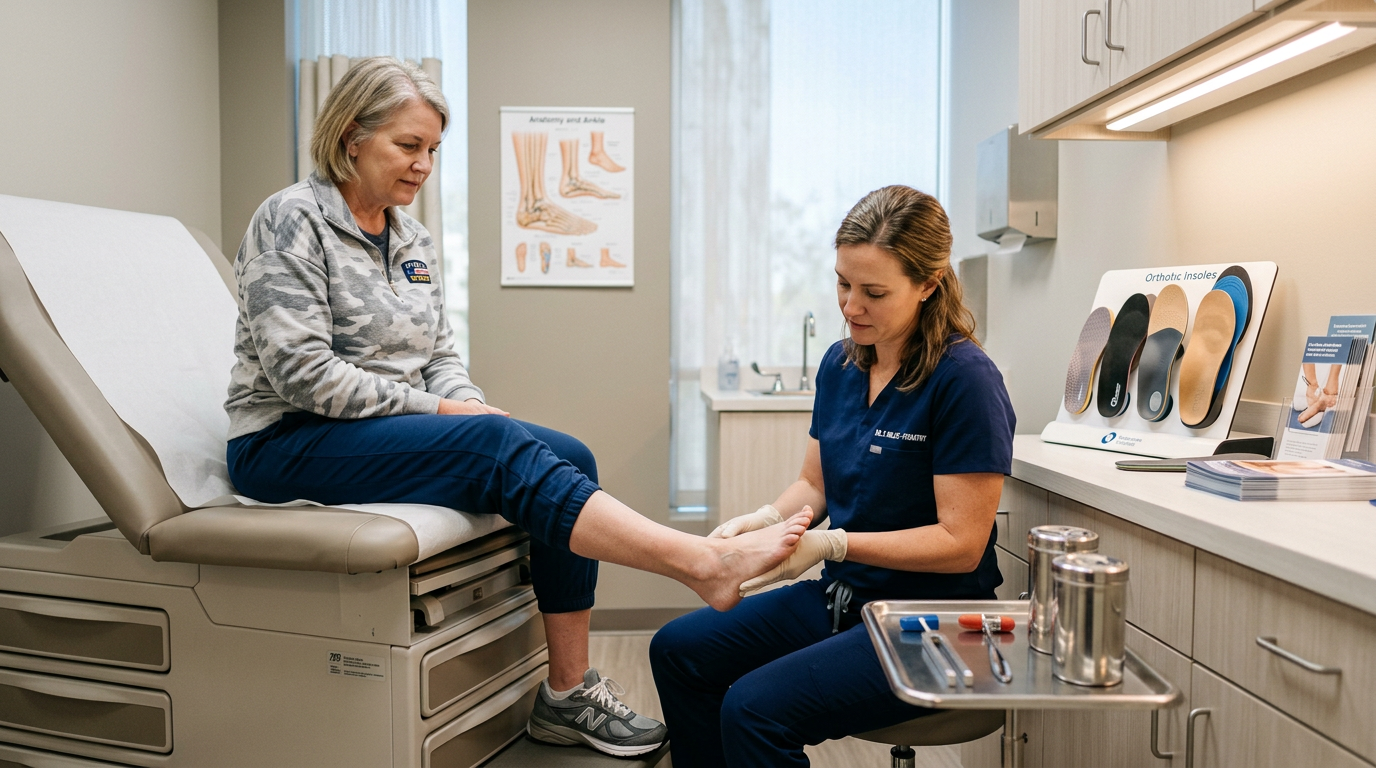
Plantar Fasciitis & Flat Feet
That stabbing pain in your heel with the first steps out of bed, and the aching, collapsing arch by the end of a long day, are not something you just have to live with. Years of marching under load, standing on concrete and running in boots that never fit right flatten the arch and inflame the band of tissue along the bottom of your foot. Both are ratable — flat feet up to 50%, plantar fasciitis on top of it — and both are wildly under-filed by women.
Everything you need is on this page, in plain English: what these conditions actually are, why they hit women veterans harder, what in your service causes them, exactly what each rating level requires, how the VA quietly underrates foot claims, and how to build one that holds up. Read it once and you will understand your own case better than most people who will ever look at it.
What These Conditions Really Are
Flat feet (pes planus) means the arch on the inside of your foot has partly or completely collapsed, so more of the sole touches the ground and the foot rolls inward (overpronation). Plantar fasciitis is the painful degeneration of the plantar fascia — the thick band of tissue running from your heel to your toes that supports the arch. The two travel together: when the arch drops, the fascia is stretched and overloaded until it starts to break down.
The classic sign is sharp heel or arch pain with your very first steps in the morning, easing as you move and then returning after standing or walking. It is not “just sore feet.” It changes how you walk, and that altered gait sends damage up the chain into your knees, hips and lower back. Two separate diagnostic codes rate these — which means, done right, they can be two separate ratings.

“Pronounced,” “bilateral,” and “not relieved by orthotics”
Severity is the ladder
Flat feet are rated mild, moderate, severe or pronounced. “Pronounced” is the top tier — extreme tenderness, marked inward displacement and severe Achilles spasm on manipulation. The exact words in your exam decide your percentage.
Bilateral doubles the value
When both feet are affected, the VA applies the Bilateral Factor — roughly an extra 10% folded into your combined rating. Pronounced flat feet in both feet is the 50% cap; the same in one foot is 30%.
Orthotics can cost you points
The rules ask whether symptoms are relieved by arch supports or orthopedic shoes. If you were issued inserts, an examiner may assume it is controlled. You must document that the pain persists despite them.

Why foot injuries hit women harder — and get filed less
Women carry the same loads over a body built differently. A wider pelvis increases the inward angle of the leg, so every march and every mile rolls the foot inward a little more — driving overpronation, arch collapse and fascia strain faster than the same training does in men. Add gear and boots sized for a male foot, and the arch simply never had a fair chance.
And because women were trained to push through and keep the mission moving, sore feet almost never made it onto sick call or into a record. Foot pain gets waved off as cosmetic or “just how feet get” — so the diagnosis and the service connection are both missed for years. The fix is not tougher feet. It is getting the deformity measured and the history written down.
By the Numbers
These figures come from the VA’s own rating schedule and clinical research. If you have been walking off this pain for years and wondering whether it is “bad enough” to matter — read them slowly. You are not exaggerating, and you are not alone.

Up to 50%
the schedular disability rating flat feet (pes planus) can carry when pronounced and affecting both feet

#1 foot claim
plantar fasciitis and flat feet are among the most frequently service-connected musculoskeletal foot conditions for veterans
Two codes
flat feet (DC 5276) and plantar fasciitis (DC 5269) are rated separately — done right, they can be two ratings, not one
+ Bilateral
when both feet are affected the Bilateral Factor adds roughly an extra 10% into your combined rating
100%
the effective pay rate available through TDIU if foot pain and its secondary conditions keep you from steady work

No deadline
there is no time limit to file — foot conditions that began in service decades ago are still claimable today
What in Your Service Causes It
These are the real, documentable origins the VA recognizes. Naming the right one — directly or as a secondary connection — is how a foot claim gets tied to your service and granted. Most denials happen simply because no one connected the dots.

Marching & rucking under load
Every mile under a ruck and body armor drives your full weight — plus dozens of extra pounds built for a male frame — straight down through the arch. Over a career that repeated compression flattens the arch and strains the plantar fascia. When the foot pain started during service and never left, that is a direct service-connection path the VA is supposed to recognize.

Standing for hours on hard surfaces
Flight lines, guard duty, the motor pool, the flight deck, hospital and chow-hall shifts — countless jobs kept women standing on concrete and steel for entire shifts. Prolonged weight-bearing with no relief is one of the most reliable ways to collapse an arch and inflame the fascia, and it rarely made it into a medical record at the time.

PT, running & repeated impact
Mandatory PT, timed runs, road marches and jumps put thousands of hard-surface impacts through the heel and arch. Repetitive impact overloads the plantar fascia — the band of tissue along the bottom of the foot — producing the microscopic tears and degeneration behind plantar fasciitis.
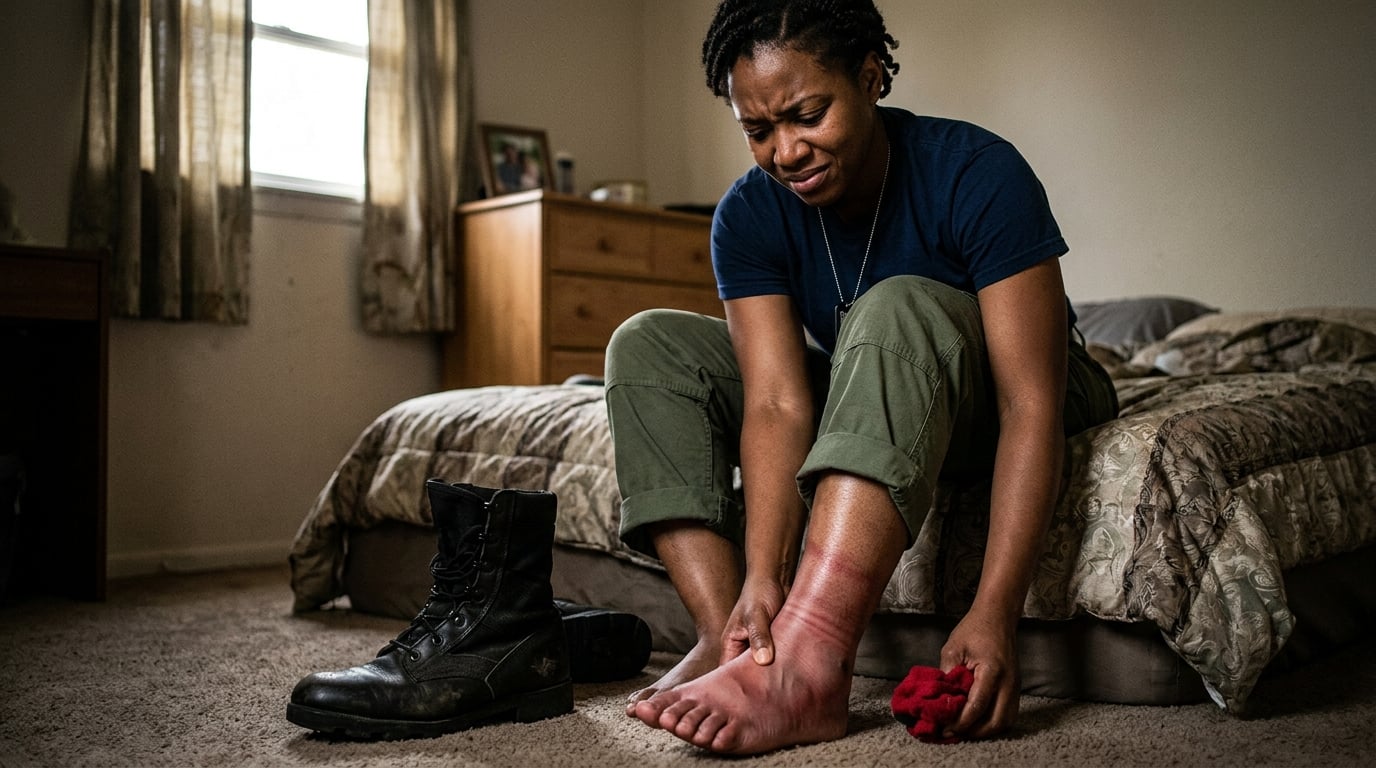
Boots built for a different foot
Boots were sized and shaped around a male foot, with arch support and width that fit many women poorly. A boot that does not support the arch forces the foot to overpronate — rolling inward — for years, accelerating both flat-foot deformity and fascia strain.
What the VA Pays for Flat Feet & Plantar Fasciitis
Feet are rated under 38 CFR §4.71a, and two separate codes matter here. Acquired flatfoot — pes planus — is Diagnostic Code 5276, and it climbs by severity and by whether one foot or both are involved: mild is noncompensable, moderate is 10 percent, severe is 20 percent unilateral and 30 percent bilateral, and pronounced is 30 percent unilateral and 50 percent bilateral. Plantar fasciitis now has its own code, DC 5269, added when the VA overhauled the musculoskeletal schedule in 2021 — before that it was rated by analogy, which is one reason so many older claims came back at zero. Under 5269 the rating rises when both feet are involved and the condition has not responded to treatment, including surgery. Because these are distinct codes for distinct pathology, flat feet and plantar fasciitis can be rated separately so long as you are not paid twice for the same symptom, which is all §4.14 prohibits. And §4.59 still applies: a painful foot is a compensable foot. Here is exactly what each level requires, in plain English.
Flat feet (pes planus), pronounced and affecting both feet — the schedular cap. Marked pronation, extreme tenderness across the soles, marked inward displacement and severe spasm of the Achilles tendon when the foot is manipulated, none of it improved by orthopedic shoes or appliances.
Flat feet, severe in both feet — or pronounced in one foot. Objective evidence of marked deformity, pain on use and on manipulation, swelling on use, and characteristic callus growth (callosities).
Flat feet, severe in one foot: that same marked deformity, pain on manipulation and use, swelling and callosities, affecting a single foot.
Flat feet, moderate in one or both feet — pain on manipulation and use, the weight-bearing line falling over or medial to (inside of) the great toe, and inward bowing of the Achilles tendon.
Flat feet, mild — symptoms relieved by a built-up shoe or an arch support. Non-compensable on its own, but it still establishes the service connection you can build on if the condition worsens later.
Plantar fasciitis is rated separately under its own code: 10% for one or both feet when it responds to treatment; 20% for one foot that does not respond; 30% for both feet that do not respond. Because a collapsed arch strains the fascia, plantar fasciitis is frequently secondary to flat feet — and when both feet are rated, the Bilateral Factor adds value on top.
Source: 38 CFR §4.71a, Diagnostic Codes 5276 (flat feet / pes planus) and 5269 (plantar fasciitis). Every percentage here is a starting point set by federal regulation, not a promise — your actual rating depends on your records and exam, and the two conditions cannot be rated for the exact same symptom twice (no “pyramiding”). An accredited representative can confirm exactly what fits your case.
One rating rarely tells the whole story
Foot conditions almost never stand alone. Add the knee, hip and back problems they cause, and the numbers combine. And if the pain and its secondary conditions make it impossible to hold down steady, gainful work, you can apply for TDIU (Total Disability based on Individual Unemployability) and be paid at the 100% rate even when your schedular total is lower. It is one of the most overlooked options for veterans whose feet quietly ended their careers.
Understanding Your Feet, in Plain Language
Foot problems are the injury veterans are most likely to dismiss and the VA is most likely to underrate, and that combination costs women thousands of dollars a year. These are clear explainers from respected medical sources on what plantar fasciitis and pes planus actually are — how the plantar fascia tears and scars under repetitive load, why the first steps in the morning are the worst, why a collapsed arch changes the mechanics of your ankle, knee, hip, and lower back, and what orthotics, stretching, injections, and surgery can and cannot fix. Years of marching, running in issued boots, standing post, and carrying gear on a frame that was never fitted for it is precisely the history the VA recognizes as causal. Watch whenever you’re ready, then get it into your medical record.
Plantar Fasciitis — Mayo Clinic
Mayo Clinic explains what plantar fasciitis is, why the heel and arch hurt most with your first steps, and how the tissue along the bottom of the foot breaks down.
Flat Feet (Pes Planus) — Everything You Need to Know
A clear medical overview of flat feet: how the arch collapses, the overpronation it causes, and why it drives knee, hip and lower-back problems up the chain.
These videos are shared for general education from third-party medical creators. They are not legal advice, and watching them is never required to get help with your claim.

How the VA Quietly Underrates Foot Claims
Foot conditions are among the most consistently lowballed claims in the schedule. The exams are quick, the severity words are subjective, and the burden of proving how bad it really is falls on you. Here is how these claims get shortchanged — so you can head it off:
- A rushed C&P exam that rates you “moderate” without measuring the deformity or checking both feet
- An examiner who sees you were issued inserts and assumes the condition is “relieved by orthotics”
- Flat feet and plantar fasciitis lumped into one rating when they are separate diagnostic codes
- The knee, hip and back pain your altered gait caused never connected as secondary conditions
This is exactly where an accredited representative earns their place — making sure both feet are examined and the deformity is measured, framing the severity correctly, separating the two codes, catching every secondary connection, and pushing back on a rating that came in too low.
Secondary Claims — The Connections Most Women Miss
Foot problems rarely travel alone. They are frequently caused by another service-connected condition — and they frequently cause new ones up the leg and into the back. Each recognized link is a separate rating you may be leaving on the table.
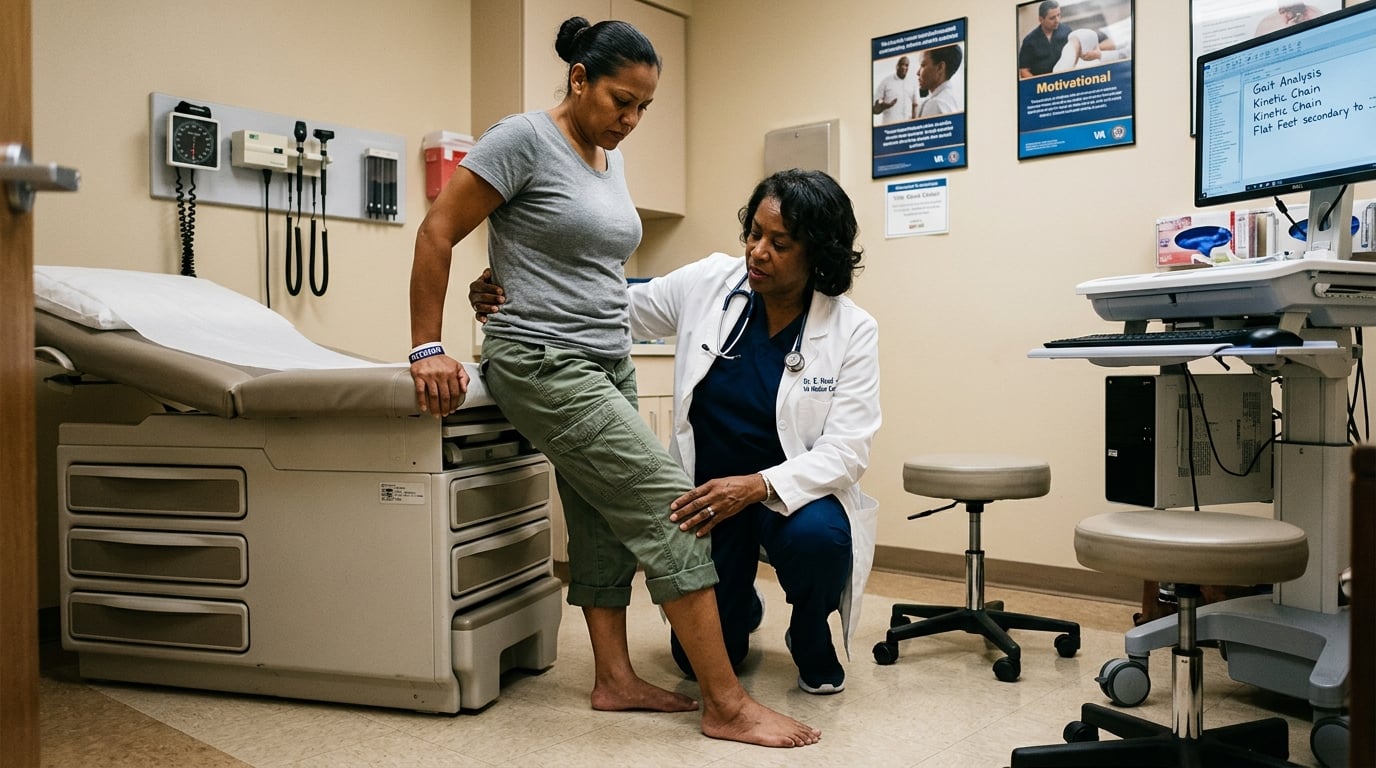
Foot problems caused by something else
If any of these is already service-connected, your flat feet or plantar fasciitis can often be connected as secondary to it:
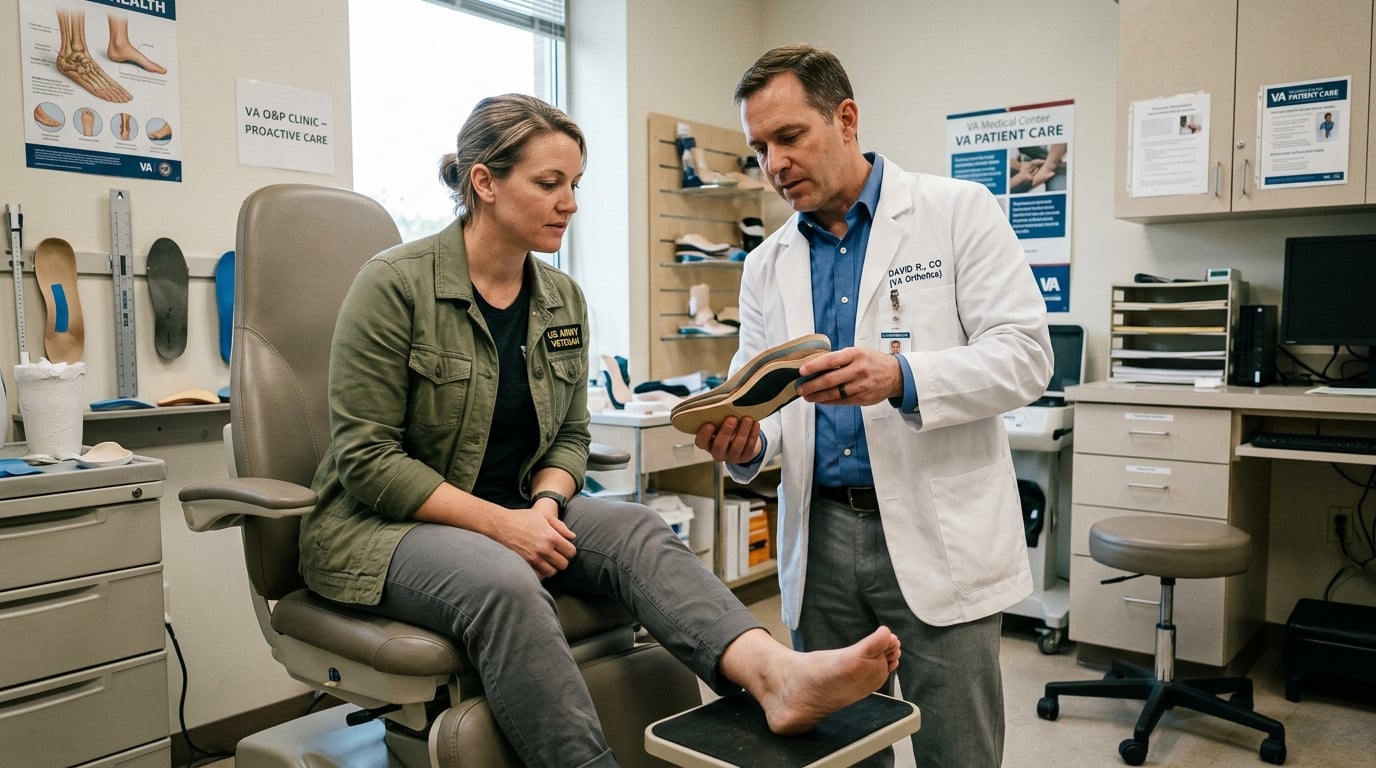
Conditions your foot problems can cause
Once your feet are service-connected, these can be claimed as secondary to them:
A secondary claim needs a diagnosis plus a medical opinion (“nexus”) saying the link is at least as likely as not. This is one of the highest-value things an accredited agent helps build.
Building a Foot Claim That Wins
A foot claim is won on documentation and connection, not on how long you have walked it off in silence. The strongest single piece of evidence is often already in your service treatment record: an entry-physical foot exam, a sick-call visit for arch or heel pain, a profile, or an issue of insoles. Pull those pages and point the rater directly at them. If the pain started in service and never left, say exactly that — continuity of symptoms is a recognized route to service connection. Describe the real limits: how far you can walk, how long you can stand, what shoes you can no longer wear, and what you gave up. Get the current diagnosis on paper, including any imaging or a podiatry note, then file: Intent to File (VA Form 21-0966) to lock the effective date, VA Form 21-526EZ for the claim, and VA Form 21-4142 to release private podiatry records. Claim the knee, hip, and back consequences at the same time under §3.310 — an altered gait damages everything above it. Here is exactly what a strong file is built from:
Every claim stands on three legs
A current diagnosis
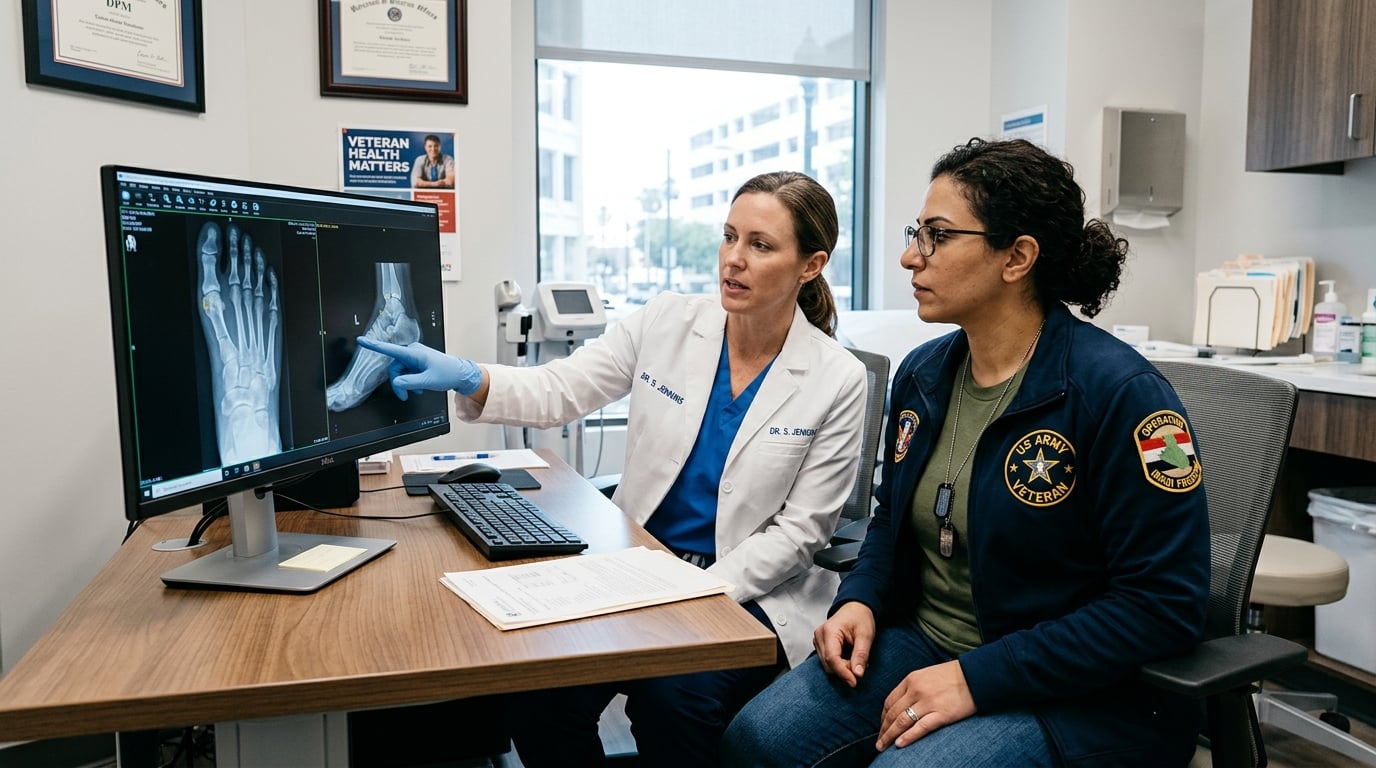
A flat-feet and/or plantar-fasciitis diagnosis on record — ideally from a podiatrist, with weight-bearing X-rays that show the arch collapse the VA rates on.
An in-service link
Evidence the foot pain began in service, or a service-connected condition (knee, hip, back, ankle) your feet can be tied to as secondary.
A nexus
A medical opinion connecting the two — stating the foot condition is at least as likely as not related to service or to the primary condition.

A simple pain log is quiet, powerful evidence
The VA rates severity, and severity lives in the details you can prove. Start a log today and keep it for a few weeks before your exam. For your feet, write down:
- The first-step morning pain — where it is, and how sharp (say it plainly)
- How long you can stand or walk before the pain forces you to stop
- Whether inserts or orthopedic shoes actually relieve it — or the pain persists anyway
- Knees, hips or back that hurt because of how you are walking
What to expect at the C&P exam
The examiner works from the Foot Conditions Disability Benefits Questionnaire (DBQ). They will look at the arch, check for tenderness and deformity, and ask how it affects standing, walking and work. Three things protect your rating:
Insist both feet are examined
If both feet hurt, both must be assessed — that is what drives the Bilateral Factor and the higher bilateral ratings.
Describe your worst days
Not your average day and never your best. Be specific: “By the end of a shift I can barely put weight on it, even with the inserts.”
Say the orthotics don’t fix it
If inserts or orthopedic shoes only take the edge off, say so clearly — otherwise the exam may record it as “relieved.”
When you are ready to file
File your claim on VA Form 21-526EZ, list flat feet and plantar fasciitis (and any secondary knee, hip or back condition), and attach your pain log, X-rays and any buddy statements. You can also open the disability calculator to see how a foot rating would combine with the rest of your conditions.
Your Rights — Know Them Before You File
The system is easier to face when you know the rules are on your side. These protections apply to your your foot condition claim from the moment you start.
You never pay a fee just to file. A VA-accredited representative can help you at no upfront cost — anyone demanding money up front to "start" your claim is a red flag.
The VA has a legal Duty to Assist — it must help you gather your service and medical records, and must tell you what evidence is still missing BEFORE it issues a denial.
You have the right to request a female provider and a trauma-informed clinician for any exam connected to your claim.
You have the right to file for every condition you live with — including secondary conditions your service-connected condition caused or made worse.
A single low rating is not the end of the road. You have the right to appeal, to submit new evidence, and to be re-evaluated as your condition changes.
If your conditions together keep you from holding steady, gainful work, you have the right to be considered for TDIU — paid at the 100% rate even if no single condition reaches 100%.
Questions Women Ask About Plantar Fasciitis & Flat Feet Claims
Straight answers to the questions that stop women from filing — or from claiming everything they are owed.
Is plantar fasciitis rated on its own, or lumped in with flat feet?
Plantar fasciitis has its own diagnostic code (5269) and can be rated up to 30 percent for both feet — it is not automatically folded into a flat-foot rating. If the VA rated everything as one foot condition, that is often a sign the decision undervalued you, and it is worth an accredited review.
My flat feet were noted when I entered service. Can I still get compensated?
Yes. A condition noted at entry can still be service-connected on the theory of aggravation — that military service made it permanently worse than its natural progression. Years of marching, rucking and standing on hard surfaces is exactly the kind of aggravation the rules recognize. You do not lose the claim just because a flat foot was checked at induction.
Why does my representative keep asking about my knees, hips and back?
Because a foot condition changes how you walk, and an altered gait puts abnormal stress up the chain. Knees, hips and the lower back commonly break down as secondary conditions to service-connected foot problems — and each one can carry its own rating. Filing the feet without capturing the secondaries leaves money on the table.
I have the same problem in both feet — does that matter?
It does. When you are rated for the same condition in both feet, the VA applies the bilateral factor, which adds an extra percentage on top of the combined rating. Many veterans with bilateral foot conditions are rated as if only one foot were involved. An accredited review can confirm whether the bilateral factor was applied correctly.
When You Are Ready to File
Before you file anything, talk to an accredited agent first — it is free. A claim is won or lost on how it is built: the diagnosis on record, the right in-service connection, and whether every condition and secondary is captured. Once a claim is submitted it is much harder to fix than to get right the first time. There is no fee to have an accredited claims agent (#45147) review your situation and tell you honestly whether and how we can help.
You now know what the VA looks for — it is all above. When you are ready, the forms themselves are downloaded and submitted on the official VA site. These are the exact ones you will use:
Resources — Save These
Every one of these is free and confidential. You do not need to be enrolled, rated, or “official” to use any of them. Tap any card to take action now — the phone numbers dial straight from your phone.