

Musculoskeletal Injuries
Back, hip, knee, ankle, shoulder and neck injuries are the single most common service-connected disability there is — and women carry them differently. Gear built around a male frame, forced onto a different body for years, does lasting damage. The pain is real, it is service-connected, and it is ratable.
Everything you need is on this page, in plain English: what these injuries actually are, why they hit women veterans harder, what in your service causes them, exactly what the VA pays at each level, how these claims get quietly lowballed, and how to build one that holds up. Nobody should be telling you the pain is “just getting older.” It is not.
What a Musculoskeletal Injury Really Is
“Musculoskeletal” simply means the bones, joints, muscles, discs and connective tissue that let you move — your spine, hips, knees, ankles, shoulders and neck. A service musculoskeletal disability is the chronic pain, stiffness and lost motion left behind after years of carrying weight the human body was never built to carry the way the military required.
This is not one injury — it is the most common category of service-connected disability of all. It shows up as a herniated disc, a worn-out knee, a bad hip, a frozen shoulder, chronic low-back strain. And the concept that governs your entire rating is one you need to understand before your exam: the VA rates these on range of motion and functional loss — not on how much you hurt in silence.
Range of motion, painful motion & flare-ups
What the VA measures
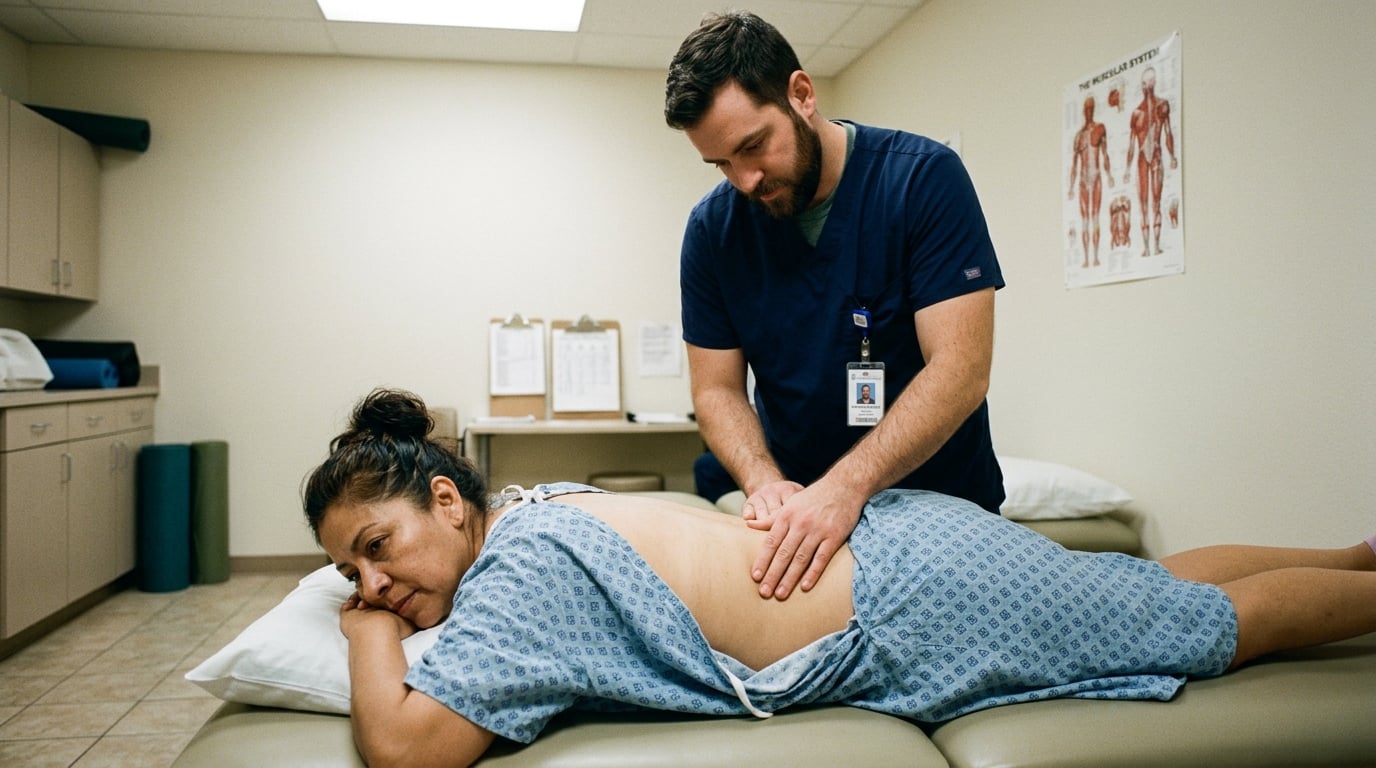
Your rating is set in degrees. At the exam a clinician measures how far each joint bends before it stops — forward flexion of the spine, flexion and extension of the knee. Less motion means a higher rating.
Painful motion counts
Under §4.59, if motion is painful the VA must assign at least the minimum compensable rating — and the exam must test both weight-bearing and non-weight-bearing motion. Do not mask the pain to look tough.
Flare-ups matter most
The examiner is required to estimate the extra loss you have during a flare-up, not just on a calm day. If you only describe your best day, you will be rated on your best day. Describe your worst.
Why women get hurt differently — and file less
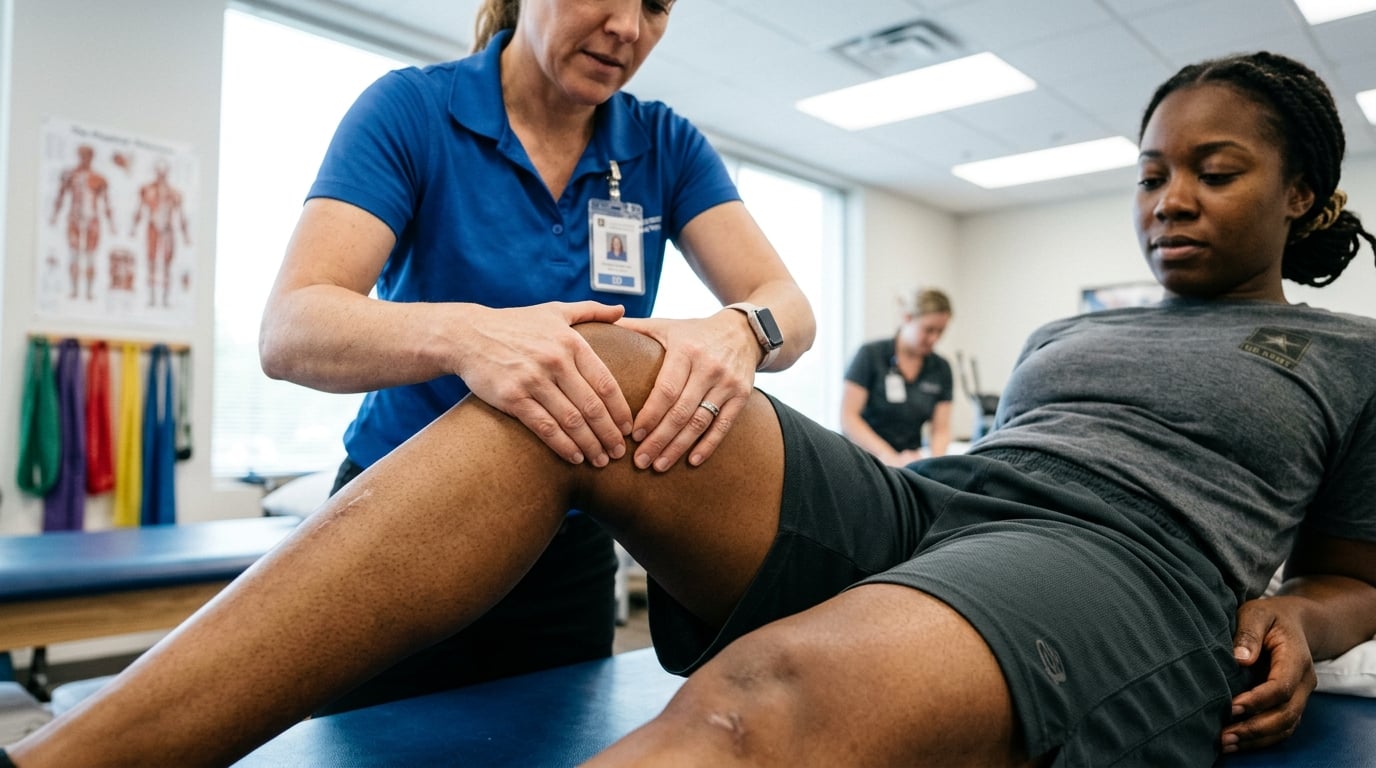
Everyone who serves takes wear-and-tear home. But women are about twice as likely to be discharged for a musculoskeletal condition — and there are physical reasons why. Body armor, rucks and load-bearing equipment were sized and balanced for a male frame, so a woman’s spine, hips and shoulders compensate for a load that sits wrong. And a wider pelvis changes the angle of the knee joint, so the same march loads her body harder.
Yet a huge share of women never file — because someone told them the pain was “normal,” or “just getting older.” It is not. It is a ratable, service-connected disability, and the fact that you pushed through it for a decade does not make it worth less. It makes the record longer.
By the Numbers
These figures come from VA disability data and the rating schedule itself. If you have been carrying this quietly, wondering whether it is “bad enough” to matter — read them slowly. You are not exaggerating, and you are not alone.
#1
Musculoskeletal conditions are the most common category of service-connected disability among all veterans
2x
Women are roughly twice as likely as men to be medically discharged for a musculoskeletal condition
10–40%
the range for a rated lower-back condition, set by how far your spine bends before pain stops it
+10%
roughly what the Bilateral Factor adds into your combined rating when both knees or both hips are affected
Q-angle
a wider pelvis loads the female knee at a harder angle — identical training does not do identical damage
No deadline
there is no time limit to file — injuries that began in service decades ago are still claimable today
What in Your Service Causes These Injuries
These are the real, documentable origins the VA recognizes. Naming the right one — directly or as a secondary connection through altered gait — is how the claim gets tied to your service and granted. Most denials happen simply because no one connected the dots.
Body armor & load-bearing gear
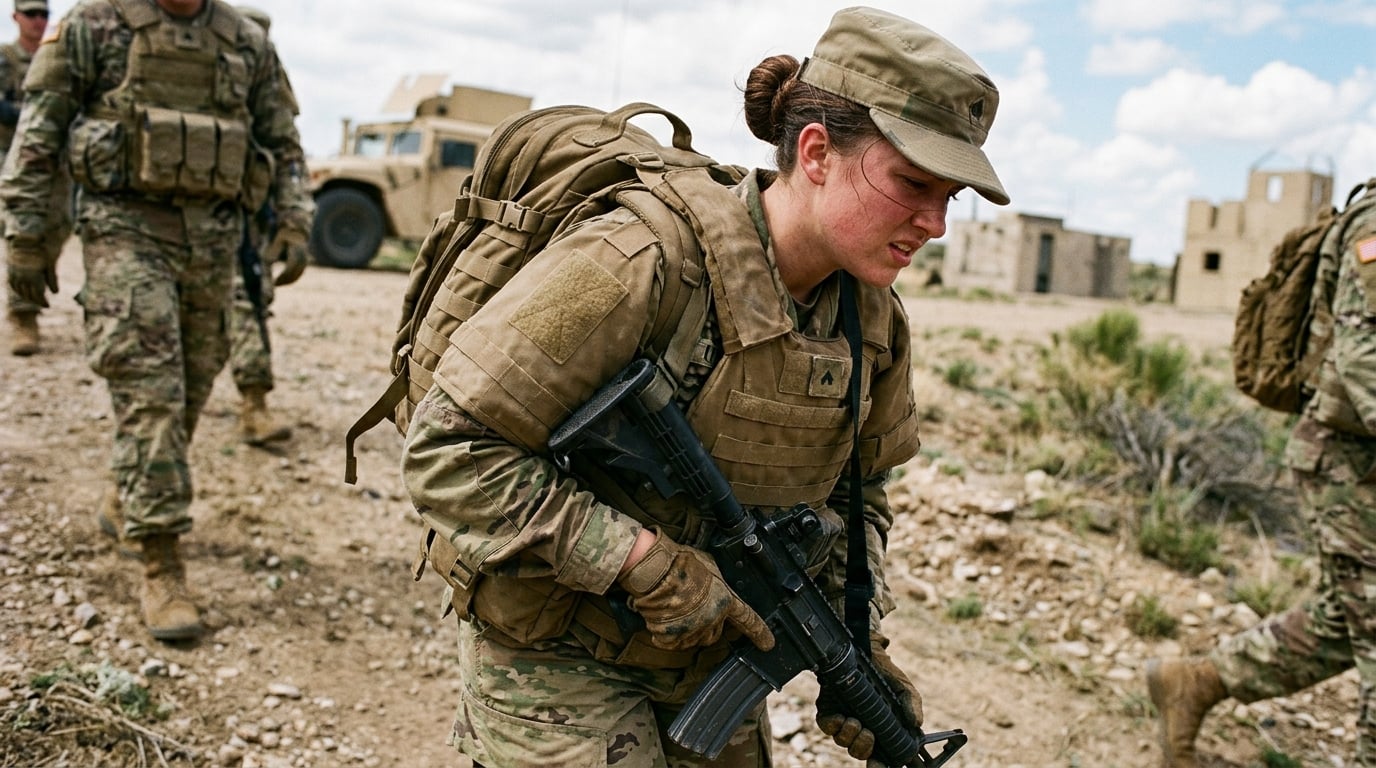
Plate carriers, rucks and web gear were engineered around a male torso. Forced onto a different frame, the load pulls the shoulders forward and the lower back into compensation for years at a time. The result is chronic lumbar, cervical and shoulder injury — damage that is directly service-connected because the equipment itself, and how you had to carry it, caused it.

Marching, running & repetitive impact
Road marches, PT runs on hard surfaces, parachute landings and rapid dismounts drive relentless impact through the knees, ankles, hips and lower back. Over a career that repetitive loading grinds down cartilage and discs — the classic “wear-and-tear” pattern the VA rates on lost range of motion.

Anatomical loading differences
A wider pelvis increases the knee’s Q-angle — the angle at which the thigh bone meets the shin. The same march, jump or lift therefore loads a woman’s knee and hip at a harder angle, accelerating wear and raising the rate of ACL and patellofemoral injuries. Identical training does not do identical damage.

Vehicle vibration & heavy lifting
Hours in armored and tactical vehicles transmit whole-body vibration straight into the spine, while lifting equipment, ammunition and casualties compresses discs and injures the lower back. Both are documentable causes of the herniated discs and chronic strain that show up years later.
What the VA Pays for Musculoskeletal Injuries
These are rated under 38 CFR §4.71a, and almost every tier turns on two things: measured range of motion and functional loss. Spine conditions — lumbosacral strain at DC 5237, degenerative arthritis of the spine at DC 5242, intervertebral disc syndrome at DC 5243 — run on the General Rating Formula, where forward flexion of the thoracolumbar spine greater than 60 but not greater than 85 degrees is 10 percent, greater than 30 but not greater than 60 is 20 percent, 30 degrees or less is 40 percent, and ankylosis climbs from there. Knees are rated on limitation of flexion under DC 5260, limitation of extension under DC 5261, and instability under DC 5257 — and instability can be rated separately from limitation of motion in the same knee without violating the anti-pyramiding rule in §4.14. Three regulations do the heavy lifting for you and are routinely ignored by examiners: §4.40 functional loss, §4.45 the joints, and §4.59 painful motion, which entitles you to at least the minimum compensable rating for a joint that hurts through its arc. Here is what each level requires, in plain English.
Lower back / lumbar spine (DC 5237 strain, 5243 disc disease): 10% when forward flexion is greater than 60 up to 85 degrees; 20% at 30 to 60 degrees; 40% at 30 degrees or less, or favorable ankylosis of the entire thoracolumbar spine. Unfavorable ankylosis rates higher still.
Knee, hip, shoulder & other joints: rated on how much range of motion you have lost (for the knee, DC 5260/5261). A separate 10–30% can be assigned for instability or “giving way” under DC 5257 — meaning one knee can carry two ratings at once.
Total knee or hip replacement (DC 5055): a full 100% for the four months after surgery, then a 30% minimum — higher when chronic pain, weakness or limited motion continues.
The Bilateral Factor: when the same paired joints on both sides are affected (both knees, both hips), roughly an extra 10% is folded into your combined rating before it is rounded. Most veterans never claim it.
Source: 38 CFR §4.71a (General Rating Formula for the Spine; knee and leg diagnostic codes). Every percentage here is a starting point set by federal regulation, not a promise — your actual rating depends on your records and exam. An accredited representative can confirm exactly what fits your case.
One number rarely tells the whole story
Musculoskeletal injuries almost never come alone — a bad back, two worn knees and a shoulder each carry their own rating, and the VA combines them (it does not simply add them). When paired joints on both sides are involved, the Bilateral Factor boosts the combined figure before rounding. And if your joints keep you from holding steady work, ask about TDIU — which can pay at the 100% rate. This is exactly where most self-filed claims leave money on the table.
Understanding These Injuries, in Plain Language
Women in service carried the same rucks, wore body armor and load-bearing equipment engineered around a male frame, and absorbed the same repetitive impact — and the orthopedic consequences show up years later as disc disease, chronic strain, joint instability, and arthritis. These are clear explainers from respected medical sources on what actually happens to a spinal disc, a knee, a hip, and a shoulder under that kind of load, why pain persists after imaging looks unremarkable, and how clinicians measure range of motion. Watch them before your C&P exam and you will understand exactly what the examiner is doing with the goniometer, why they ask you to move until it hurts, and why saying “that is where the pain starts” out loud matters under 38 CFR §4.59. Watch whenever you’re ready.
Understanding & Easing Chronic Knee Pain
A physical-therapy walk-through of what drives chronic knee pain and simple movements that help — useful background for understanding a service-connected joint injury.
Understanding Back Pain — Causes, Relief and Prevention
Mayo Clinic explains what actually drives chronic low-back pain, how carrying loads and repetitive strain break down the spine over years, and which treatments help.
These videos are shared for general education from third-party medical creators. They are not legal advice, and watching them is never required to get help with your claim.

How the VA Quietly Underrates These Claims
Back and joint claims are among the most frequently lowballed in the entire system — because the rating turns on a few minutes of range-of-motion measurement that is easy to get wrong. Here is how they get shorted, so you can head it off:
- A rushed C&P exam measured on a good day that never captures your flare-ups or worst days
- An examiner who fails to test painful motion, or skips weight-bearing testing the rules require
- One low number assigned while the instability, radiculopathy and bilateral factor go unclaimed
- Pain written off as “age” or “degenerative” instead of connected to the years you served
This is exactly where an accredited representative earns their place — making sure the exam is done right, every joint and secondary is on the claim, the bilateral factor is applied, and a rating that came in too low gets challenged.
Secondary Claims — The Connections Most Women Miss
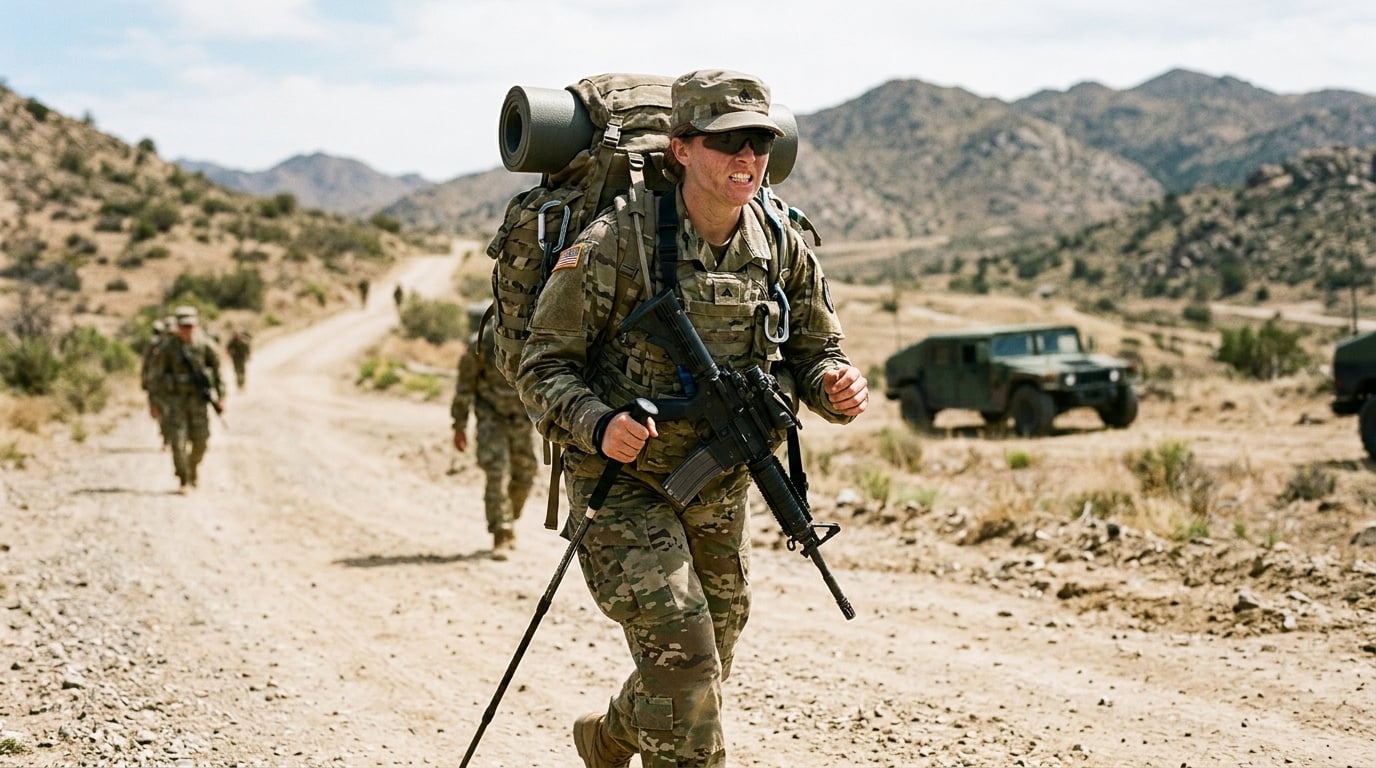
Musculoskeletal injuries rarely travel alone. One injured joint causes damage elsewhere through altered gait — and a spine or joint condition causes new problems of its own. Each recognized link is a separate rating you may be leaving on the table.
Injuries caused by another condition
If any of these is already service-connected, the joint damage it caused can often be connected as secondary:

Conditions these injuries can cause
Once a back or joint condition is service-connected, these can be claimed as secondary to it:
A secondary claim needs a diagnosis plus a medical opinion (“nexus”) saying the link is at least as likely as not. This is one of the highest-value things an accredited agent helps build.
Building a Claim That Wins
A musculoskeletal claim is won on documentation and connection, not on how much you have endured in silence — and orthopedic claims punish stoicism harder than almost any other category, because the rating is literally a measurement of what you can still do. If you push through the range-of-motion test without saying where the pain begins, the examiner records the higher number and you are paid for the higher number. Say it. Describe the flare-ups, the days you cannot get out of bed, and what you can no longer lift, carry, or kneel for, because §4.40 and §4.45 require that functional loss during flare-ups be considered, not just the degrees measured on a good morning. Then build the file: Intent to File (VA Form 21-0966) to freeze the date, VA Form 21-526EZ to file, VA Form 21-4142 to release private orthopedic, chiropractic, and physical-therapy records, plus buddy statements from anyone who watched you struggle. Here is exactly what a strong file is built from:
Every claim stands on three legs
A current diagnosis
A diagnosed condition on record — backed by imaging (X-ray, MRI) or a clinical exam showing the arthritis, disc damage or instability.
An in-service link
Evidence it began or worsened in service: sick-call and profile records, your MOS and its physical demands, and buddy statements about the injury.
A nexus
A medical opinion connecting the two — stating the condition is at least as likely as not related to service or to another service-connected injury.

A flare-up log is quietly one of your strongest pieces of evidence
The VA is required to account for flare-ups, but the examiner only sees the day you show up. Keep a simple log for a month or two before your exam. For each bad stretch, write down:
- The date and how long the flare lasted
- What you could not do — bend, lift, climb stairs, stand, sleep
- The pain level and where it radiated (down the leg or arm counts — that is radiculopathy)
- Whether you missed work, needed help at home, or leaned on a cane or brace
What to expect at the C&P exam
The examiner works from a joint or spine Disability Benefits Questionnaire (DBQ) and measures your range of motion with a goniometer. Three things protect your rating:
Do not push through the pain
When they test motion, stop where it actually starts to hurt. Powering through hides the loss the rating is based on.
Describe your flare-ups
Tell them plainly how much more you lose on a bad day and how often bad days happen — they are required to account for it.
Name every joint & symptom
Raise each affected joint, any instability, numbness down a limb, and altered gait — do not let one be left off.
When you are ready to file
File your claim on VA Form 21-526EZ, list every affected joint (and any secondary connection), and attach your flare log, imaging and buddy statements. You can also open the disability calculator to see how these ratings would combine — including the bilateral factor — with the rest of your conditions.
Your Rights — Know Them Before You File
The system is easier to face when you know the rules are on your side. These protections apply to your your back, neck and joint conditions claim from the moment you start.
You never pay a fee just to file. A VA-accredited representative can help you at no upfront cost — anyone demanding money up front to "start" your claim is a red flag.
The VA has a legal Duty to Assist — it must help you gather your service and medical records, and must tell you what evidence is still missing BEFORE it issues a denial.
You have the right to request a female provider and a trauma-informed clinician for any exam connected to your claim.
You have the right to file for every condition you live with — including secondary conditions your service-connected condition caused or made worse.
A single low rating is not the end of the road. You have the right to appeal, to submit new evidence, and to be re-evaluated as your condition changes.
If your conditions together keep you from holding steady, gainful work, you have the right to be considered for TDIU — paid at the 100% rate even if no single condition reaches 100%.
Questions Women Ask About Back, Neck & Joint Claims
Straight answers to the questions that stop women from filing — or from claiming everything they are owed.
The VA rated my back low even though I can barely bend. Why?
Musculoskeletal ratings turn largely on measured range of motion — and if the exam happened on a good day, or the examiner did not account for pain, weakness, fatigue and flare-ups, the number comes out too low. VA rules (the DeLuca and Correia standards) require the examiner to consider painful motion and repeated use over time. Many low ratings are simply exams that ignored those rules.
Can one bad back or knee lead to other ratings?
Yes, and this is where a lot of value is left on the table. A spine condition can cause radiculopathy (nerve pain down the arms or legs) that is rated separately, and an altered gait from a bad knee, ankle or foot can wear out the other joints, hips and back — each of which can be claimed as secondary.
Do I need a documented in-service injury?
Not always a single dramatic one. Repetitive strain — the rucks, the gear, the jumps, the years of physical duty — is a recognized cause. Buddy statements, your MOS, and any sick-call or profile notes help establish it even when there was no one big accident on record.
What should I do about flare-ups at the C&P exam?
Describe your worst days, not your best. Tell the examiner how far your motion drops during a flare, how often flares happen, and what you cannot do when one hits. Under Correia, the joint should be tested for pain on both active and passive motion and weight-bearing — if that was not done, that alone can be grounds to challenge the rating.
When You Are Ready to File
Before you file anything, talk to an accredited agent first — it is free. A claim is won or lost on how it is built: the diagnosis on record, the right in-service connection, and whether every condition and secondary is captured. Once a claim is submitted it is much harder to fix than to get right the first time. There is no fee to have an accredited claims agent (#45147) review your situation and tell you honestly whether and how we can help.
You now know what the VA looks for — it is all above. When you are ready, the forms themselves are downloaded and submitted on the official VA site. These are the exact ones you will use:
Resources — Save These
Every one of these is free and confidential. You do not need to be enrolled, rated, or “official” to use any of them. Tap any card to take action now — the phone numbers dial straight from your phone.